Notice of the Ministry of Agriculture on Printing and Distributing the Emergency Monitoring Plan for Animal H7N9 Avian Influenza and the Emergency Disposal Guide for Animal H7N9 Avian Influenza (Trial

To further strengthen animalsH7N9Avian influenza prevention and control work, comprehensively strengthen epidemic investigation and virus monitoring, and deal with emergencies in a timely manner. Our department organized and formulated the "Animals"H7N9Avian Influenza Emergency Monitoring Program and AnimalsH7N9Guidelines for Emergency Disposal of Avian Influenza (Trial) are hereby printed and distributed to you, please follow them.

                 The Ministry of Agriculture of the People’s Republic of China

                  2013yearfourmoonsevensun

animalH7N9Avian influenza emergency monitoring program

I. Purpose of monitoring

Grasp and understandH7N9The source, host range, transmission route and harm degree of avian influenza virus in animal groups; In order to clear the animal population in timeH7N9The pathogen of avian influenza provides scientific basis.

Second, the monitoring scope

(1) Core monitoring area

Human infection has occurred.H7N9Avian Influenza Cases and Animals Confirmed by National Avian Influenza Reference LaboratoryH7N9Avian influenza positive provinces.

(2) Key monitoring areas

Provinces adjacent to the core monitoring area.

(3) General monitoring area

Provinces outside the above two types of monitoring areas.

Third, the monitoring object

Chickens, waterfowl (ducks and geese) and artificially raised pigeons and quails; Wild birds; Live pigs.

Fourth, the number of monitoring

(1) Live poultry trading market

Each market collects not less thanthirtyThe corresponding blood samples, throat and cloacal swabs of each poultry should cover as many kinds of poultry and stalls as possible.

Each province in the core monitoring area collects all live poultry trading markets, and each county (city, district) in the key monitoring area collects at least.oneA live poultry trading market, other monitoring areas in each place (city, state) at least collection.oneA live poultry trading market.

(2) Poultry slaughterhouses

Each poultry slaughterhouse collectsthreeMore than 10 poultry groups, and each poultry group is collected.thirtyCorresponding blood samples, throat and cloacal swabs of 10 poultry.

All poultry slaughterhouses are collected in each province in the core monitoring area, and at least in each province in the key monitoring area.10A poultry slaughterhouse, other monitoring areas at least collected in each province.fiveA poultry slaughterhouse.

(3) Poultry farms (villages)

Each poultry farm (village) shall collect not less thanthirtyThe corresponding blood samples, throat and cloaca swabs of each poultry should cover as many poultry houses (households) as possible.

Each county (city, district) in the core monitoring area shall collect at leastthirtyPoultry farms (villages); Each province in the key monitoring area shall collect at leasttwentyPoultry farms (villages); Other monitoring areas shall be collected at least in each province.10A poultry farm (village).

Once the pathogen test results of samples collected by poultry farms (villages) are positive, all poultry farms (villages) in the county where the farm (village) is located shall be monitored.

(4) Habitat of wild birds

Collect fresh feces of wild birds. Collect throat and cloaca swabs from wild birds that can be captured.

(5) Pig slaughterhouse

Each slaughterhouse shall collect nasal swab of pigs at least.thirtyShare. Each province in the core monitoring area shall collect at leasttwentySlaughterhouse, the key monitoring area of each province at least collection.10Slaughterhouse, other monitoring areas at least collected in each province.fiveA slaughterhouse.

(6) Others

Each province shall determine the sampling quantity of environmental samples at the above-mentioned sites by itself.

V. Detection methods

(1) Serological detection

Using hemagglutination inhibition (HI) test, detection of serumH7Hemagglutinin antibody of subtype avian influenza virus. Refer to Diagnostic Techniques for Highly Pathogenic Avian Influenza (GB/T 189362003).HIThe experiment was carried out,HIAntibody level ≥2fourThe result was positive.

(2) Pathogenic detection

Recommended by the Ministry of AgricultureRTPCROr fluorescenceRTPCRDetection method: throat and cloaca swab samples are detected.H7Subtype avian influenza virusHAGene fragment. According to the recommended reagent (box) instructions.

VI. Monitoring Time

do all one can to do sth2013yearfourFinish before the end of the month.

VII. Division of tasks

The Veterinary Bureau of the Ministry of Agriculture is responsible for organizing the implementation, the China Animal Disease Prevention and Control Center is responsible for work coordination and data collection and analysis, and the National Avian Influenza Reference Laboratory is responsible for providing technical support and diagnostic reagent supply.

The provincial veterinary administrative department is responsible for organizing the implementation of the monitoring work in this area, the provincial animal disease prevention and control institutions are responsible for the pathogen detection, and the city and county animal disease prevention and control institutions are responsible for the serological detection, and may also entrust relevant units to carry out the detection.

VIII. Relevant requirements

(a) the implementation of the express system for positive results.Positive samples were detected by serology of animal disease prevention and control institutions at city and county levels, and sent to provincial animal disease prevention and control institutions for pathogen detection, with positive results.2Report to the competent veterinary department at the same level within hours. Provincial animal epidemic disease prevention and control institutionsoneReport the positive results to the provincial veterinary authorities and China Animal Disease Prevention and Control Center within hours.24Send the positive samples to the National Avian Influenza Reference Laboratory within hours. China animal epidemic disease prevention control centeroneReport the situation to the Veterinary Bureau of the Ministry of Agriculture within hours. The National Avian Influenza Reference Laboratory immediately reported the diagnosis to the Veterinary Bureau of the Ministry of Agriculture.

(two) the implementation of weekly reporting system for monitoring.Provincial animal disease prevention and control institutions every Monday.10The monitoring results will be summarized and reported to China Animal Disease Prevention and Control Center through the National Animal Disease Monitoring and Epidemic Information System. China Animal Disease Prevention and Control Center every Monday.twelveThe summary results will be reported to the Veterinary Bureau of the Ministry of Agriculture and copied to China Animal Health and Epidemiology Center.

(3) Carry out retrospective monitoring.China Animal Disease Prevention and Control Center, China Animal Health and Epidemiology Center and provincial animal disease prevention and control institutions2012yearoneRelevant samples preserved since June, carried out.H7Retrospective monitoring of subtype avian influenza.

(4) Make a good record of sample collection.Standardize the filling of sampling records to ensure that the records are true, accurate and traceable. All samples should be registered, reviewed, signed and sealed step by step.

(5) Standardize the disposal of positive cases.Monitoring found positive, in strict accordance with the "animals"H7N9Guidelines for Emergency Disposal of Avian Influenza (Trial).

Contact information:

veterinary bureau of the ministry of agriculture

Contact: Wei Wu, Tel:01059191401, fax:010–59192861;

China animal epidemic disease prevention control center

Contact: Fu Wen, Tel:01059194601, fax:010–59194711;

China Animal Health and Epidemiology Center

Contact: Shen Chaojian, Tel:053285648038, fax:053285653716;

National Avian Influenza Reference Laboratory

Contact: Deng Guohua, Tel:13946057836; Fax:045151997166.

animalH7N9Guidelines for Emergency Disposal of Avian Influenza (Trial)

I. Scope of application

This guide stipulates that animalsH7N9Positive confirmation, disposal, emergency epidemiological investigation and personnel protection of avian influenza.

Second, positive confirmation

H7Subtype reverse transcriptionPolymerase chain reaction (RTPCR) or fluorescent reverse transcriptionPolymerase chain reaction (fluorescenceRTPCR) test results are positive, forH7Subtype avian influenza virus infection is positive.

Provincial animal disease prevention and control institutions diagnosed asH7If the subtype avian influenza virus infection is suspected to be positive, it shall be sent to the National Avian Influenza Reference Laboratory to review the results. The National Avian Influenza Reference Laboratory will carry out a review and other related work before making a diagnosis. According to the final diagnosis results, the Ministry of Agriculture confirmed thatH7Subtype avian influenza virus infection is positive.

Third, positive treatment

Infected group refers to the animal group where the positive samples are collected, including the following three types: one is the same animal in the farm, the other is the same poultry in the live poultry market, and the third is the same poultry in the rural area.

Diagnosed by provincial animal disease prevention and control institutions as followsH7If subtype avian influenza virus is suspected to be positive, all animals in the field (village) where the infected group is located shall be restricted from moving.

Confirmed by the Ministry of Agriculture asH7If the subtype avian influenza virus is positive, all animals in the infected group shall be culled, the culled animals and their products shall be treated harmlessly, strict disinfection measures shall be implemented for the internal and external environment of the infected group’s field (village), pollutants or suspected pollutants shall be treated harmlessly, and the polluted places and facilities shall be thoroughly disinfected. If the infected group is in the trading market or slaughterhouse, the trading market or slaughterhouse should be closed immediately. The trading market or slaughterhouse can only be opened after the provincial veterinary authorities and relevant departments have passed the analysis and evaluation.

Animals other than the infected group in the same field (village) shall be monitored again after the infected group is disposed of, and shall not be allowed to move until there is no positive infection.

Fourth, emergency epidemiological investigation

rightH7If subtype avian influenza virus infection is positive, emergency epidemiological investigation and etiological study shall be conducted with reference to the "Specification for Epidemiological Investigation of Highly Pathogenic Avian Influenza".

V. Personal protection

In emergency response, personnel protection shall be strictly implemented in accordance with the Technical Specification for Personnel Protection of Highly Pathogenic Avian Influenza.

The most comprehensive mobile game app list 2022 top ten mobile game platform app list

Game software can usually be divided into game boxes, game tools, game assistants and other categories, which can help game lovers download interesting game resources, learn the latest game information, query game strategies and so on. Even some game softwares have the functions of modifying games, speeding up games, downloading cracked versions and delivering benefits, which are far more powerful than everyone thinks. What are the most comprehensive mobile game app rankings? Next, let Xiaobian share the app rankings of the top ten mobile game platforms in 2022 for everyone!

First, Milu bt mobile game platform

,

User recommendation:

Conscience platform, giant factory, game buff blessing

Thousands of games, masterpieces gathered, super high game rebates.

Download and enjoy the free GM privilege immediately, and even have the exclusive gift package of the European emperor!

Second, the nine demonsBt mobile game platform

,

Nine Demons APP is a game app owned by Batu, and users can receive the first reward qualification provided by the app.

Brand features:

When users go online, they will be given VIP and infinite diamond ingots, and the platform recharge ratio can reach 1:1000. You can also get extra gifts through recharge!

Third, BatuBt mobile game platform

,

Reasons for recommending Batu Game Box:

China’s leading mobile game welfare platform has nearly 5,000 popular mobile games.

Free first charge, automatic discount for recharge, discount as low as 30%,

Send VIP online, get the gold ingot for free, and definitely play the necessary artifact of mobile games.

Iv. 3733Bt mobile game platform

,

3733 Many platform features:

Free first charge, online full V, unlimited ingots,

Discount recharge, mobile game acceleration, gm privilege, massive gift package,

Bring the ultimate gaming experience to players!

Fifth, loveBt mobile game platform

,

Evaluation of fun games:

Abnormal game download portal, the scale is leading in China, accommodating the most complete BT mobile game in the market.

Lead the players to know the latest information about the opening service of BT mobile games and enjoy the fun of mobile games.

Self-help application for all game rebate activities, official service quality, SF experience!

Vi. 277Bt mobile game platform

,

277 Game app provides players with:

BT version, discount version, H5 game encyclopedia, players want all kinds of games.

There is a discount for any amount of money on the platform, and there is no obstacle to recharging at any time.

Game official service quality and public service experience.

Seven, YOXIBt mobile game platform

,

Many platform features of YOXI mobile games:

Super welfare mobile game platform, providing high-quality H5 games, popular online games and role trading.

Ultra-low discount+super gift package+value voucher

Recharge only needs to pay the discounted price, all online games are 40% off, and vouchers are discounted.

The pit abandonment game can be recycled and exchanged for vouchers at any time.

Eight, can be setBt mobile game platform

,

Diskable game features

Super welfare game platform, cracked mobile game and mobile game discount recharge platform.

Abundant discount game offers are easy to receive!

Recommend your favorite types of games every day; A variety of rich benefits are sent together.

Nine, btgo metamorphosisMobile game platform

,

Btgo game highlights:

Abnormal online games, online games, GM, H5, discount games; Self-service rebate can reach up to 500%

Download all kinds of game resources for free, such as abnormal version and full V version.

Free first charge, and recharge will be automatically discounted.

Free first-time vouchers, large vouchers, and multi-platform welfare packages

X. HeheBt mobile game platform

,

Hehe, mobile app user benefits:

There are all kinds of games on the mobile game box, and new users register to send the first charge.

You can get out-of-print vip packages and enjoy various benefits when you go online.

Hehe, the mobile game platform has recharge and rebate.

The above is the list of the top ten mobile game platforms in 2022 brought by Xiaobian. If you want to experience more, more fun and more classic bt mobile games, I suggest you pay attention.18183bt mobile game information, or pay attention18183bt mobile game zoneThere will be a large number of different versions of bt boxes recommended here!

A 14-year-old girl in Xianning, Hubei Province was forced into prostitution, and a 50-year-old businessman was sentenced to seven years in prison for rape.

  On November 12th, Red Star journalists from Xianning, Hubei Province "14-year-old girl was forced ‘ Prostitution ’ " The family of the victim was informed that recently, the local court has made a judgment on the case. The defendant Fu Qiuquan was convicted of rape and sentenced to 7 years in prison. Fu Qiuquan and others compensated the victims for various economic losses of more than 324,000 yuan.

  According to Red Star News, on April 30, 2019, Fu Qiuquan, a 55-year-old businessman in Xianning City, Hubei Province, had forced sexual relations with Li Fang (a pseudonym), who was 14 years old and coerced.

  Behind this, it is a complete illegal "buying place" chain composed of multi-layer middlemen, "clients" and victims.

  The People’s Court of Xian ‘an District of Xianning City said in the first-instance judgment that it was found through trial that in 2018, after meeting Lu Yu, a woman who runs a bar in Xianning, Fu Qiuquan repeatedly said that he was willing to pay a high price to find a virgin to "buy a place" for transshipment because his business was not smooth.

  After Lu Yu and his employee Lareina C cheated the victim Li Fang out of his home through layers of relationships, and then restricted Li Fang’s personal freedom, and asked Li Fang to "engage in prostitution" through repeated "persuasion" and coercion.

  ↑ The court found through trial that the victim was coerced and induced by many people.

  On the night of the murder, Fu Qiuquan forced sexual relations with Li Fang while Li Fang was nervous, crying and resisting. That night, Fu Qiuquan paid Lareina C 8000 yuan in two installments. This 8000 yuan was divided by Lareina C and others, and Li Fang did not score.

  During the trial of the case, after judicial appraisal, Li Fang met the diagnostic criteria of "post-traumatic stress disorder", and his social function was obviously damaged, and his disability grade was rated as Grade 10.

  Li Fang’s family told Red Star News that after the incident, Li Fang suffered from mental illness and has been receiving medication. "In recent years, it has cost more than 20,000 yuan to see a doctor, stay in hospital and buy medicine."

  In August 2020, the People’s Court of Xian ‘an District of Xianning City made a criminal judgment on the case of Lareina C and Lu Yu introducing prostitution. The court said in the judgment that Lareina C and Lu Yu constituted the crime of introducing prostitution, and both of them could be given a lighter punishment according to law because they pleaded guilty.Lareina C was sentenced to 1 year and 6 months in prison and fined 7,000 yuan. Lu Yu was sentenced to 1 year and 4 months in prison and fined 5,000 yuan..

  Recently, Fu Qiuquan’s case of committing rape has also reached a verdict. The contents of the verdict of the People’s Court of Xian ‘an District, Xianning City obtained by the Red Star journalist show that during the trial, Fu Qiuquan argued that the victim had sex with him voluntarily, and he did not commit coercion, which did not constitute rape.

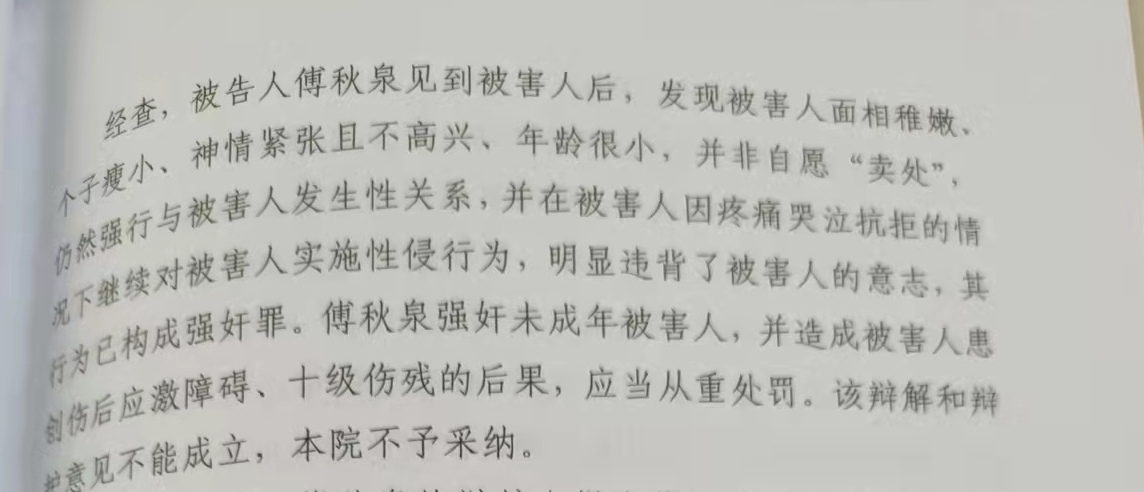
  In this regard, the Xian’ an District Court stated that after seeing the victim, Fu Qiuquan found that the victim was immature, thin, nervous and unhappy, and very young. He did not voluntarily "sell the place" and still forced to have sex with the victim. He continued to commit sexual assault when the victim cried and resisted because of pain, which obviously violated the will of the victim, and his behavior constituted rape.

  ↑ The court said that Fu Qiuquan’s sexual assault clearly violated the will of the victim.

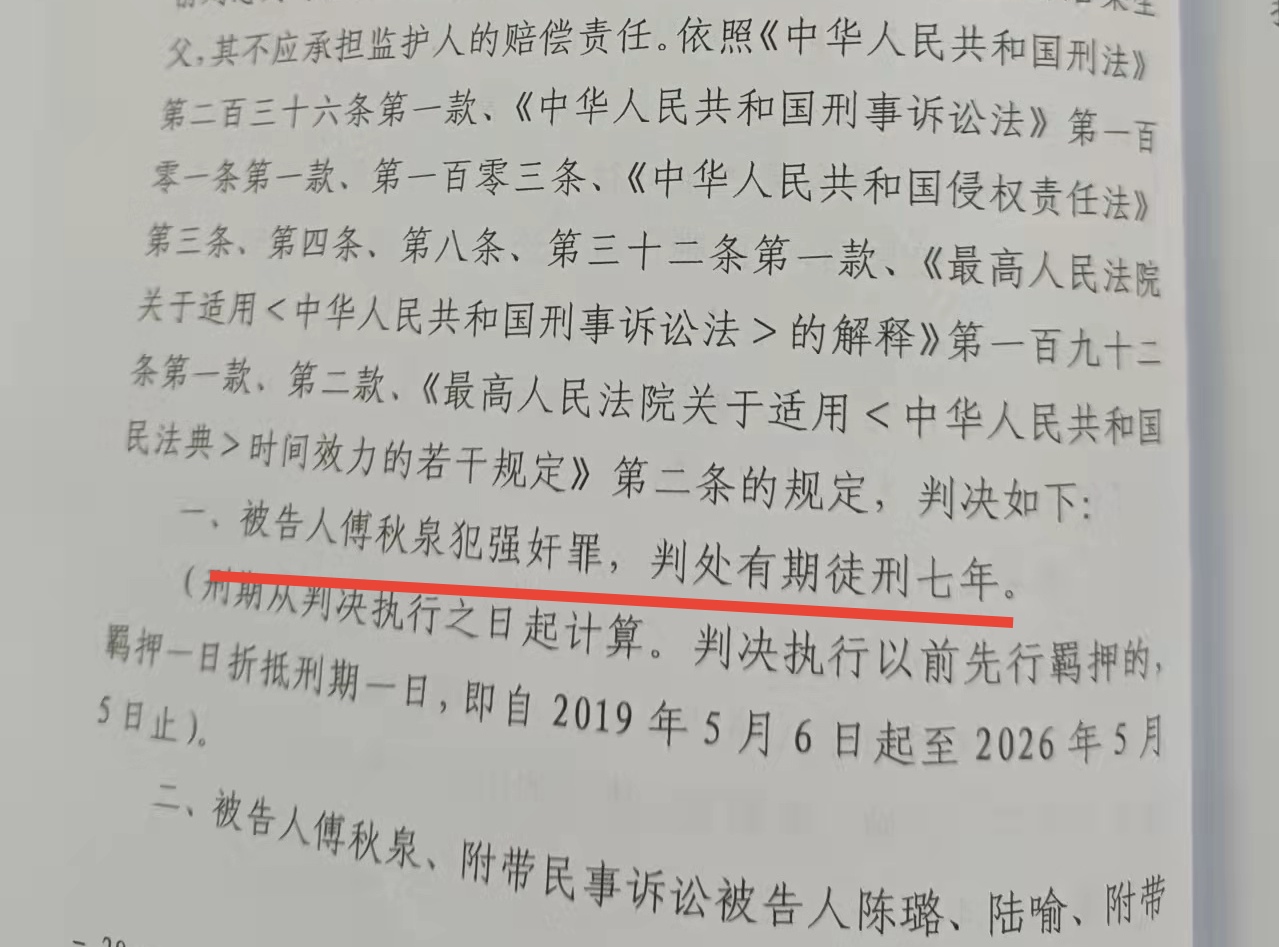
  The Xian ‘an District Court also stated that Fu Qiuquan should be severely punished for raping a minor victim and causing the victim to suffer from post-traumatic stress disorder and grade 10 disability.Fu Qiuquan was sentenced to 7 years in prison for rape..

  ↑ Fu Qiuquan was sentenced to 7 years in prison for committing rape.

  The Red Star journalist also noticed that the victim’s family filed an incidental civil lawsuit.

  In the judgment, the Xian ‘an District Court mentioned that the victim in this case, as a minor with immature mind, had weak self-regulation and self-repair ability. After being infringed, he was repeatedly admitted to a specialized hospital for treatment due to depression and negative thoughts. It can be concluded that Fu Qiuquan and others’ infringement behavior caused serious mental damage to the victim.

  "Combined with the principle of priority and special protection for minors, our court believes that this case can be considered as a special case that meets the conditions of compensation for mental losses in incidental civil proceedings." At the same time, the court made an incidental civil judgment,Fu Qiuquan, Lu Yu and Lareina C were ordered to compensate the victims for various economic losses of more than 324,000 yuan..

Let researchers concentrate on their research

    Scientific research environment is a general term for all kinds of direct and indirect factors that affect scientific and technological personnel to engage in scientific research activities. A good scientific research environment is conducive to researchers to concentrate on research and stimulate their creative vitality, which is of great significance to promoting scientific and technological progress and implementing the innovation-driven development strategy.


    In recent years, the basic situation of scientific research environment in China has aroused widespread concern and debate from all walks of life, and has been highly valued by the relevant national science and technology management departments. In order to deeply understand the cognition of scientific researchers in various provinces (autonomous regions and municipalities directly under the Central Government) on the scientific research environment in their respective regions, the research group of the Institute of Science and Technology Policy and Management Sciences of the Chinese Academy of Sciences, with the support of the China Association for Science and Technology, selected five types of sites, including universities, research and development institutions, park enterprises, large and medium-sized industrial enterprises and medical and health institutions, and distributed 8,074 questionnaires to scientific researchers directly engaged in R&D activities, with 7,868 returned and 7,691 valid questionnaires. On the basis of this investigation, combined with the statistical data of science, technology, economy and society in 2012, this paper made a comprehensive evaluation of China’s scientific research environment.


The researchers gave positive comments on the current scientific research environment as a whole.


    First, the conditions of scientific research infrastructure have improved significantly, and nearly 30% of researchers feel that they have sufficient funds and full tasks.


    According to the survey, nearly 80% of the researchers think that the basic conditions of scientific research have improved obviously, among which 65% think that the basic conditions of scientific research in their institutions are at the middle and upper-middle level in China, 10% think that they are at a higher level in China, and only a little over 20% think that the basic conditions of their institutions are poor. At the same time, when it is necessary to obtain relevant experimental materials or consult scientific research references in scientific research activities, more than half of them feel convenient or very convenient, and only 20% think it is inconvenient or inconvenient. In terms of scientific research intensity and task fullness, nearly 30% feel full of funds and tasks, nearly 30% spend more than 40 hours a week directly engaged in scientific research activities, and nearly 30% feel that scientific research tasks are challenging. This reflects that in recent years, with the continuous increase in the total amount of scientific research funds invested by the central and local governments, the basic conditions of scientific research work in China have been greatly improved, and the tasks of scientific researchers are generally full, especially those who study abroad, have high academic qualifications, and have high professional titles. The recognition of the basic conditions of scientific research in their units is the highest.


    Second, the degree of scientific research cooperation and professional division of labor has been significantly strengthened, and researchers generally recognize the norms of teamwork.


    Institutions are equipped with full-time, high-level scientific research assistants, and the formation of a relatively close network of partners among scientific researchers is an important factor to improve the efficiency and level of scientific research work. The survey results show that the cooperation and professional division of labor among researchers have improved to some extent. In the same organization, the frequency ratio of other colleagues to undertake and complete the scientific research auxiliary work reaches 30%, which is higher than the frequency ratio of handling the scientific research auxiliary work by themselves without auxiliary personnel at all; At the same time, the frequency ratio of scientific research collaborators from their own institutions is as high as 44%, and the units where more than 85% of scientific researchers work actively encourage cross-departmental or inter-institutional cooperation. However, it is common for graduate students to help teachers undertake scientific research auxiliary work, which is much higher than the proportion of full-time auxiliary personnel, which shows that there is still much room for improvement in the scale of teamwork in scientific research units. About 40% of the team leaders’ influence comes from their academic level and strategic vision. About 40% of the team members have consultation and communication, and respect each member’s own choice. Another three quarters of the team results are distributed according to actual contributions, and more than half of the researchers have a strong sense of belonging to the team, which reflects the recognition of most researchers on the existing team cooperation model.


    Third, researchers give positive comments on the scientific research management ability of their units and are optimistic about the career development space.


    The survey shows that about 90% of researchers give positive comments on the overall impression of the scientific research management department of the unit, among which nearly 60% think that the auxiliary scientific research services and the overall innovation atmosphere of the unit are "generally acceptable" or "very good", and nearly 70% think that the current performance evaluation mechanism is reasonable. At the same time, most researchers have remained relatively stable in their work. From the observation of the flow of researchers in their own units in the past two years, more than 80% of researchers have not felt the frequent outflow of other researchers, and they are satisfied with the career development space in their own units. Only less than 15% researchers are "not satisfied" or "very dissatisfied" with the career development space in their own units, hoping for other better development opportunities. The work of the party and government organs is still attractive to a considerable number of researchers. If there is an opportunity to transfer to the party and government organs at the same level or to start a business, more than 50% of researchers will consider moving. Generally speaking, good working environment, personal development space, stable work, more learning opportunities, and giving full play to their abilities are the main reasons why most researchers choose to stay in their current work units.


    Fourth, the scientific and technological innovation policy has been well received by researchers, and the implementation and implementation need to be further strengthened.


    In recent years, the central and local governments have issued a series of policies and supporting measures to encourage scientific and technological innovation, attract high-level talents and promote the development of high-tech industries. Researchers generally recognize these incentive policies, and nearly 40% of them think that the policies are good and fully affirm them. More than half of the researchers still hope that the government will increase its encouragement and support. For the implementation of these policies, 8% of researchers think that the effect is very good, and 38% think that "some encouragement policies have been implemented, and the overall effect is ok", which is basically the same as the overall proportion of "the implementation is not good, the effect is not great, and these policies are basically not felt". This shows that the implementation of relevant science and technology policies has not been widely recognized, and the urgent task is to enhance the scientific nature of policies and further increase publicity and implementation.


Six outstanding problems reflected by scientific researchers


    First, a large number of institutions lack systematic and efficient innovation management capabilities.


    All kinds of institutions in Industry-University-Research generally don’t know enough about the law of creative activities in scientific research, which is manifested in the weak ability of specialized division of labor and cooperative management of scientific research organizations, and they are used to managing scientific researchers by means of administrative management and engineering management, and lack of supporting for truly valuable "creative" work, which makes a large number of scientific researchers’ enthusiasm consumed in low-level repetitive daily chores. On the one hand, scientific researchers frequently work overtime, on the other hand, about 70% of scientific researchers directly engage in scientific research activities for less than 40 hours a week. According to the survey, only 16% of the researchers think that the unit attaches great importance to innovation, and about 50% of the researchers think that the incentive effect of scientific research and innovation in their unit is not good; 34% of the respondents think that although the company has formulated some incentive measures, the overall incentive atmosphere for innovation has not yet emerged, and 8% of the respondents think that there is basically no difference between innovation and non-innovation in the company.


    Second, the investment and allocation of science and technology funds are not targeted to people.


    In recent years, China’s investment in scientific research has increased rapidly, and it has become the third largest country in the world. These greatly increased scientific and technological funds have achieved remarkable results in improving the basic conditions of scientific research and other "hardware facilities", but they are insufficient in investing people, especially young and middle-aged researchers with more innovative vitality. The survey shows that the current research funding, task pressure and work intensity basically present three "one-third" situations, that is, in terms of sufficient research funding and full tasks, there are one-third of people who feel full, average and lacking; In terms of the pressure and challenge of scientific research work, one-third of the people feel very stressed, less stressed and more moderate; At the same time, the proportion of people who spend more than 40 hours, less than 20 hours, and between 20 hours and 40 hours is also one-third of three. In addition, researchers with different professional titles have significant differences in their cognition of individual environment. The actual working time intensity and the proportion of challenging scientific research work of deputy senior and intermediate researchers are higher than those of senior researchers, but their satisfaction in scientific research activities, funding commitment and academic exchanges is lower than that of senior researchers, which also shows that the allocation of scientific and technological resources is insufficient to support this group.


    Third, most researchers still lack high-level and international academic exchange opportunities.


    It is found that the internationalization level of scientific and technological research in China has become an important factor that restricts the improvement of scientific researchers’ ability. 44% of researchers "mainly participate in academic conferences or scientific and technological group exchanges organized by domestic organizations", and two-thirds of researchers choose to publish their scientific research results in China because "there will be some language or channel barriers abroad". Less than 15% of researchers can publish their academic research results internationally without obstacles, and only 11% can participate in foreign academic exchanges relatively freely and conveniently. More than 40% of researchers said that they "seldom have academic exchanges" and "lack relatively high-level academic exchange opportunities", and 16% of researchers still have obvious obstacles in terms of regions, institutions or languages even if they publish their scientific research results in China, reflecting that some researchers’ channels for participating in academic exchanges are not smooth enough, and their academic exchange ability needs to be further strengthened.


    Fourth, the publicity and transparency of the allocation mechanism of scientific and technological resources are not enough.


    For the research funding mechanism of local government departments, except for 32% researchers who did not give a clear judgment, less than 5% clearly chose "the whole funding mechanism is open and transparent", while the proportion that "the process is very opaque and all kinds of hidden rules are very serious" is as high as 13%, and 30% researchers think there are some unfair and unreasonable places, "but not very serious"; Another nearly 20% of the staff think it is not bad on the whole, which has greatly improved compared with the past. In addition, some researchers specifically mentioned the problem of "unfair project application" in the allocation of scientific research funds, which is reflected in the prevalence of "learning hegemony" in the formulation, application and evaluation of project guides. I hope that the setting and funding mechanism of related scientific research projects will be more open and transparent.


    Fifth, the academic community and scientific and technological associations have not played a sufficient role.


    Academic communities and scientific and technological societies are important carriers to strengthen the education of scientific values and integrity of researchers and promote academic exchanges. According to the survey, nearly one-third of the researchers’ overall impression of the scientific and technological associations in this region said that they seldom contact with scientific and technological organizations, more than half thought that the scientific and technological organizations in this region were not active enough, nearly 8% said they knew something about a certain scientific and technological association, and less than 3% of the researchers had a better understanding of the society and gave a "good impression" evaluation. It can be seen that the majority of scientific researchers have obviously insufficient understanding and participation in scientific and technological associations, and the scientific and technological associations that should play an important role as carriers and intermediaries in developing academic norms, shaping scientific values and promoting academic exchanges have not fully played their roles at present. Strengthening the self-construction of "academic communities" and enhancing the value recognition of scientific researchers are the weak links in the current development of China’s scientific community.


    Sixth, the overall cultural atmosphere of social innovation is not ideal.


    A good social innovation atmosphere is an important prerequisite to stimulate the innovation enthusiasm and vitality of researchers, and it is also an important aspect that researchers pay attention to. It is found that the atmosphere of social tolerance failure, challenge to academic authority and academic independence, which are necessary for creative work, is not highly evaluated by researchers. Nearly half of the researchers think it is general, and the proportion of ideal or unsatisfactory is about 20%. In terms of improving the social image and political status of scientific and technological personnel, 50% of scientific and technological personnel think that there is no obvious difference from other occupations. Among them, only 19% think that the social status of researchers in this area has been greatly improved, and nearly a quarter of researchers think that despite a lot of publicity in various aspects, there has been no substantial improvement; Generally speaking, most researchers think that compared with other groups, the social status has not improved much.


    Analysis of the crux of the above problems mainly lies in the lack of creativity of scientific researchers and the low level of independent management of scientific research activities.


    First, the substantial increase in investment in science and technology has improved the working conditions of researchers, but it will not automatically bring about the same improvement in the satisfaction of researchers with the scientific research environment.


    According to the survey, the higher the level of researchers, the more scientific and technological resources they occupy, and the higher the quality requirements for the scientific research environment. Senior and senior researchers who have studied abroad and are at the top of the group of researchers are significantly superior to other groups in terms of basic conditions for scientific research, research funds, publication of achievements and opportunities for academic exchange, and they are also in a dominant position in teamwork. At the same time, they attach great importance to the norms of teamwork and have higher requirements for the scientific research management level of their units. This situation shows that innovation management and cultural issues are replacing the lack of investment in science and technology, and become the main problems restricting the improvement of the current scientific research environment in China. It requires government management departments and various scientific research institutions to explore macro-and micro-management mechanisms that are more in line with the laws of scientific and technological innovation activities.


    Second, the conflict between the increasing demand for scientific autonomy and the administrative science and technology management system has become one of the main contradictions in the macro-management system of science and technology in China.


    The intervention of too many external administrative forces makes the degree of independent management of scientific researchers, scientific research institutions and scientific communities insufficient, which not only reduces the efficiency of scientific research and management, but also affects the enthusiasm and sense of accomplishment of scientific researchers as knowledge workers. In particular, some scientific research institutions and management departments lack of attention to the laws of scientific research and innovation activities, and the management methods focus on planning and administration. There is a big gap between the management ability of creative activities and the actual needs of scientific researchers, which leads to the phenomenon of simple management methods, repeated work by scientific researchers and a lot of work in vain to some extent. In addition, the imperfect public participation mechanism in the allocation mechanism of scientific and technological resources leads to the insufficient participation of the scientific community and the public in public scientific and technological affairs, and the low recognition of the fairness and impartiality of the government in allocating resources is also an important reason that affects the positive evaluation of the scientific research environment by researchers.


    In short, although the scientific research infrastructure conditions of various units have improved significantly in recent years, all units and government scientific and technological management departments are also vigorously strengthening scientific research performance management, promoting scientific research cooperation, and actively introducing a series of incentive policies for scientific and technological innovation; However, the survey found that researchers still generally feel that it is difficult to give full play to their creativity, and their units and scientific and technological management departments lack systematic and efficient innovation management capabilities, which has become the main obstacle to improving the scientific research environment. This also means that innovation management and cultural issues are replacing the overall lack of investment in scientific and technological resources, becoming an important factor affecting researchers to judge the quality of scientific research environment, and further requiring government management departments and various scientific research institutions to explore macro-and micro-management mechanisms that are more in line with the laws of scientific and technological innovation activities.


Suggestions on respecting the law of scientific research activities and promoting the process of independent management of scientific research institutions and researchers


    To improve the scientific research environment, we must strengthen the regular understanding of scientific research activities and management, give full play to the initiative and creativity of scientific and technological personnel, and greatly expand the participation scope and discourse power of scientific communities and the public in government scientific and technological affairs. The research group suggested that:


    Efforts should be made to ensure the time for scientific researchers to directly engage in scientific research activities.


    Increase the steady support for public scientific research institutions, simplify the scientific research management and evaluation mechanism, and shorten the time for scientific researchers to participate in administrative affairs and other social affairs activities; With the positive attitude of "releasing water to raise fish", we will support scientific researchers to concentrate on their scientific research work, and guide front-line scientific researchers to gradually increase their time directly engaged in scientific research activities to three-fifths or even more than four-fifths of their normal working hours.


    Piloting the reform of the comprehensive supporting system of different types of scientific research institutions.


    Actively explore the governance model of public scientific research institutions in the new period, and select some basic and public research institutes with high scientific research level to carry out pilot reform of comprehensive supporting system. The pilot work focuses on rationalizing the operating mechanism of scientific research institutions in terms of personnel, finance, materials, activities and comprehensive management, and establishes a coordinated scientific research management system of personnel-post-funds-activities-evaluation; While fully mobilizing the initiative and enthusiasm of researchers, we should strengthen the independent management of scientific research at all levels and stimulate the creativity of researchers.


    Strengthen the right to speak of scientific community in scientific and technological affairs of the whole society.


    Give full play to the academic norms and value guidance functions of the scientific community. Gradually reduce all kinds of scientific and technological awards led by the government; Strengthen the leading role of professional societies, trade associations and other professional groups and social organizations in academician selection, scientific and technological awards and evaluation, suppression of academic misconduct, establishment of academic journals, and dissemination of scientific and technological news; Strengthen peer review in scientific research organization evaluation, project evaluation, talent recruitment and other matters; Let the scientific community rebuild academic norms and innovative values.


    Establish a more transparent and higher social participation mechanism for the allocation of scientific and technological resources.


    Reform the allocation mechanism of public scientific and technological resources, improve the participation of scientists and the public in the process of public scientific and technological decision-making and project organization and implementation, and reduce the direct intervention of government departments in the process of scientific and technological project organization and implementation. Strengthen the construction of social supervision and management mechanism, and promote the opening of all kinds of scientific and technological projects and scientific and technological infrastructure supported by public finance to the whole society.


    Significantly increase the budget for supporting scientific researchers to "go global".


    Implement the strategy of "going out" for researchers, and rapidly improve their research vision and international communication ability. Significantly increase the amount of international scientific and technological cooperation and exchange funds of the National Scholarship Fund Committee, China Academy of Sciences and other departments, while building a high-level international academic exchange platform, increase support for front-line scientific researchers and young and middle-aged scientific research management backbones, and maintain the growth rate of more than 30% for three to four consecutive years.


    Explore the implementation of "inclusive" science and technology policies and encourage "mass innovation".


    Taking generate, which encourages and stimulates the creativity of the whole society, as an important part of the construction of innovative cities, we should not explore and implement the "inclusive" all-staff innovation project for all kinds of enterprises, institutions and the public based on the qualification theory of innovative subjects; Continue to promote the work deployment of "Several Opinions on Strengthening the Work of Innovative Methods" by the four national ministries and commissions, and constantly promote and popularize the knowledge of innovation methodology such as TRIZ in society and various enterprises and institutions; Increase the creative methods and scientific aesthetic education content in primary and secondary education, vocational education and training, and higher education, and form a pluralistic and inclusive mass innovation culture atmosphere for all social subjects. (Author of research group of Institute of Science and Technology Policy and Management Science, Chinese Academy of Sciences: Leng Min, Song Qi) 


发布于 分类 restert标签

Announcement of State Taxation Administration of The People’s Republic of China on Issues Concerning the Issuance of VAT Invoices

State Taxation Administration of The People’s Republic of China Announcement No.16 of 2017

  In order to further strengthen the management of value-added tax invoices, ensure the smooth implementation of the pilot project of changing business tax into value-added tax, protect the legitimate rights and interests of taxpayers, and create a healthy and fair tax environment, the relevant issues concerning the issuance of value-added tax invoices are hereby announced as follows:

  1. Since July 1, 2017, if the buyer is an enterprise, the taxpayer identification number or unified social credit code shall be provided to the seller when requesting the general VAT invoice; When the seller issues an ordinary VAT invoice for it, it shall fill in the taxpayer identification number or unified social credit code of the buyer in the column of "taxpayer identification number of the buyer". Invoices that do not meet the requirements shall not be used as tax vouchers.

  The enterprises mentioned in this announcement include companies, unincorporated enterprises as legal persons, enterprise branches, sole proprietorship enterprises, partnerships and other enterprises.

  2. When the seller issues a VAT invoice, the contents of the invoice shall be truthfully issued according to the actual sales situation, and the contents inconsistent with the actual transaction shall not be filled in according to the requirements of the buyer. When the seller issues an invoice, it will interface with the background of the VAT invoice tax control system through the sales platform system, and import relevant information for invoicing. The content of invoicing data imported by the system should be consistent with the actual transaction. If it is not consistent, the sales platform system should be revised and improved in time.

  It is hereby announced.

State Administration of Taxation (SAT)

May 19, 2017

Spring Festival travel rush is a kind of persistence and a kind of inheritance.

  Headed by a hundred years, the four seasons spring is the first. Spring Festival travel rush is a huge "migration" of hundreds of millions of people, a hearty gathering, and also the power output of transportation with the greatest energy, and the railway is the first choice for travel. To this end, the railway people’s persistence has become a mission, and it has been running through Spring Festival travel rush for 40 days, and the "Great China Territory" carrying the flow of mountains and rivers of the motherland is unimpeded.

  Spring Festival travel rush, let every guardian embark on a journey with a sense of mission. There are smiling faces where you can see them, and there are silent dedication behind the scenes, and they persist in hard struggle. In the cold wind, they climb mountains and wading to illuminate the way home for you; In the middle of the night, they burn the midnight oil to provide inexhaustible kinetic energy for railway transportation; In the mountains, they fought against the wind and snow, sticking to their posts; At the small station, they are lonely and send and receive trains on time; High in the air, they are bold and cautious, tightening the strings in their hands. The two rails extend to the direction of our home, which is also the direction of their struggle.

  Persistence is a kind of responsibility and courage to take responsibility. From day to night, railway people, accompanied by stars and rails, practice their initial intention and mission of serving the people with their persistence, and show the responsibility and responsibility of the iron shoulders in the new era with youth. Sticking to one’s post has become the most beautiful scene in Spring Festival travel rush, and writing a new story about Spring Festival travel rush, a railway man.

  Persistence is a kind of spirit and conveys feelings. Among the adherents on Spring Festival travel rush Road, there are many "husband and wife stalls" and "father and son soldiers" who stick together. They are like relay races, passing on their dedication and showing their simple feelings of home and country in their ordinary posts. Spring Festival travel rush culture has become a cultural gene shared by railway people from generation to generation in the changes of the times, leaving a distinct brand of continuous inheritance.

  Going home is a kind of inheritance. Spring Festival travel rush is also a kind of inheritance. One deed is worth a thousand words. "Small family loves big", and father and son are United, which is a "common partner" on the front of Spring Festival travel rush, and it is also the inheritance and persistence of the spirit of railway people. Spring Festival travel rush is a big test and an eternal complex. It is its responsibility to protect people’s lives and property, to serve the overall stability of society, and to defend the soil and do its duty.

  I saw a beauty of giving up my family and serving everyone. All of them have profound educational significance for the Chinese people. It is always worth remembering! Spring Festival travel rush, a time that needs to be interpreted by struggle. On the way home for thousands of tourists, persistence is their enterprising struggle, adhering to the development thought of "people-centered", burying their thoughts in their hearts and interpreting their responsibilities with persistence.

  A hundred years is the first, and everything starts well! Firmness is a kind of standing, and defense is a kind of responsibility. Hold Spring Festival travel rush’s baton, continue to inherit the railway spirit of our predecessors, assume the responsibility and responsibility of railway people in the new era, and jointly protect every Spring Festival travel rush for the rest of his life. Continuing Spring Festival travel rush’s cultural ties and the blood of civilization, and inheriting the confidence of China culture on the long road to Spring Festival travel rush’s hometown, we savor the fragrance of our homeland and the local accent in our ears, feel the endless mystery of Spring Festival travel rush culture, and weave and draw a warm picture that touches China with persistence and inheritance. (Text/Golden Water)

China’s trade goes global, starting from the thirteen lines in Qing Dynasty.

China’s trade went global. From 1757 to 1842, the 13th Canton was the only "special zone" for the Qing government to trade with Europe and the United States, which made the city retain its memory and make people remember its homesickness. Guangzhou is a famous cultural city with a history of more than 2,000 years. Every street and lane has a long story, and every brick and tile has a meaningful memory. Today, Xiaobian will appreciate the heavy memory of this city with you, appreciate the spirit tradition of tolerance and openness for more than 2,000 years, and appreciate the endless literary context; Together with you, under the illumination of history, we can understand today and Guangzhou, thus strengthening our cultural self-confidence. In 1757, with the promulgation of the imperial edict on foreign trade in which Qianlong only left Guangdong Customs, the foreign trade of the Qing Dynasty was locked in the thirteenth line of Guangzhou. As the only exchange center between Chinese and Western civilizations for 85 years, it is a Chinese and foreign trading place located on the edge of the Pearl River, where foreign ships gather at the thirteen ports, and almost all major countries and regions in Asia, Europe and America have had direct trade relations with the thirteen banks. It has global trade routes to Europe, Latin America, South Asia, East Asia and Oceania. It was the only surviving node of the Maritime Silk Road under the closed-door policy of the Qing government at that time, bearing the gestation and development of modern China’s commercial economy. Although the thirteen lines have disappeared in the long river of history, their historical influence has been continuing. Two hundred years later, history once again chose Guangzhou to undertake the historical mission of "gathering customers from all over the world and selling goods from all over the world". Thirteen lines and the Canton Fair jointly compose the colorful movement of the Maritime Silk Road.It became the epitome of China’s opening to the outside world and economic development in modern times. A long scroll showing the style of the thirteen-line business hall in Qing Dynasty. Where did the thirteenth line come from? Kangxi’s sea trade gave birth to the "Thirteen Lines" and made Guangzhou "trade in one mouth". This was a scene in the 18th century-the Swedish merchant ship King Frederick was sailing off the South China Sea in China. This is a large sailboat of that era. It started from Europe and will arrive in Canton after more than a year’s voyage. In the eyes of westerners, China is a country of silk, porcelain and tea, and there are countless exquisite handicrafts, showing a profound culture. They were pleasantly surprised to find China. Fortunately, the Swedish ship escaped the stormy waves of the Cape of Good Hope, the piracy in Malacca and the threat of epidemic diseases on board, and completed the voyage with 20% staff reduction. Only half of the sailboats that set out with them can reach Guangzhou. Paying such a high price is for the maiden voyage of trade between China and Sweden. After leaving Gothenburg, Sweden, King Frederick went to Spain for the silver that was commonly used in China, and arrived at Lingding Island in Guangzhou on September 6, 1732. During the four months of berthing in Guangzhou, King Frederick ordered 151 large boxes and 1801 bundles of porcelain from more than 10 foreign firms in China, totaling 49,906 pieces. And 2183 boxes of red and green tea. After sailing from Guangzhou, King Frederick returned to Sweden after eight months. Porcelain exported in the Qing Dynasty is bright in color. At that time,Every year, hundreds of such merchant ships come from afar, enter the South China Sea of China through a long waterway, and then go north along the Pearl River to reach Guangzhou, then known as the southern gate of the Eastern Empire. In fact, during the Ming Dynasty, overseas trade was not always smooth, and the imperial court often declared a "sea ban", which lasted until the early Qing Dynasty. In the Ming and Qing Dynasties, the sea was closed for 300 years. However, Guangzhou’s ship management organization, Shiboshi, was preserved and continued to play a role in promoting cultural exchanges between China and foreign countries. The model of the Swedish merchant ship Gothenburg, which sailed to Guangzhou three times in Qing Dynasty. After Kangxi unified Taiwan Province and put down the San Francisco Rebellion, he began to consider the economic and tax balance of the whole country. He sent Shi Zhu, a cabinet university student, to Guangdong and Fujian for inspection to prepare for the sea trade. Because smuggling is popular, there is opposition in the court. Kangxi asked Shizhu, "How many houses have you been to in Guangdong?" Shizhu replied: "Zhaoqing, Gaozhou, Lianzhou, Leizhou, Qiongzhou, Guangzhou, Chaozhou, etc., where the people said that they had left their homeland for more than 20 years, and now the emperor has leveled the bandits and can go back to their homeland." Kangxi asked again, "So, people are happy to live by the sea, why don’t you allow it?" Shizhu replied, "The sea was sealed in the Ming Dynasty, so we can only do as usual." Kangxi was very dissatisfied and said: "The frontier ministers should take the national economy and people’s livelihood as their thoughts. Although the sea is forbidden today, people who trade privately also go to sea to make a living; To be honest, if you are not allowed, it is just for your own convenience. " Shizhu was speechless for a while. In the 24th year of Emperor Kangxi of Qing Dynasty (1685), the imperial court opened four ports for trade: Guangzhou, Ningbo, Zhoushan and Xiamen.However, at that time, there was no distinction between Chinese and foreign trade, and there was no specialized foreign trade firm. In the early days of the switch, when western ships arrived, officials were in a hurry, and foreign ships were often blocked outside the port and could not trade for a long time. In the spring of 1686, the second year of Guangdong Customs switch, the Guangdong government finally found a solution-Wu Xingzuo, Governor of Guangdong and Guangxi, Li Shizhen, Governor of Guangdong, and Yi Ergtu, the supervisor of Guangdong Customs, jointly discussed and divided the national tax into two categories: "residence tax" and "line tax". The "residence tax" is a tax levied on all goods landed in the inland trade of this province, which is collected by the tax department and called "Golden Line"; "Travel tax" is a tax on goods sold by foreign countries and goods traded at sea, which is collected by Guangdong Customs. "Foreign goods line" means "thirteen lines". When it comes to the meaning of "line", it means "line and column", which is "the place where goods live". From then on, foreign goods company 13 became a professional firm engaged in foreign trade, which was managed by the state to prevent free exchanges between Chinese and foreign people. In the twenty-second year of Qianlong (1757), Qianlong made a decree in the Forbidden City: "The port is set in Guangdong, and foreign ships are allowed to dock in Guangdong." The other three ports were closed, and Guangzhou became the foreign trade center of Qing Dynasty. This export painting in Qing Dynasty depicts the scene of local businessmen talking with foreign businessmen. How prosperous is the thirteenth line? The 85-year-old "one-stop trade" has made Guangzhou’s routes to the world increasingly developed. In addition to the routes to the Indian Ocean, Nanyang, Japan and Europe that have been in use in the Ming Dynasty, it has also increased the routes to North America, Oceania and Russia through the Cape of Good Hope.In many places overseas, there are scenes of merchants from various countries shuttling around the "canton" thirteen-line commercial pavilion area and tens of thousands of races on the river, which makes people marvel at the prosperity of Guangzhou at that time. Although according to the regulations of the government, foreign businessmen could not live in Guangzhou at that time, but only in the suburbs or Huangpu Port, every rest day, businessmen or sailors could walk into the city gate and visit the flower pagoda and longevity temple of Haikuang Temple, and they could also visit scenic places such as Baiyun Mountain and Fangcun Flower Land. Guangzhou, a trading port, became the preferred "golden port" for western merchant ships after the opening and closing of the Qing Dynasty. Of course, silk porcelain, tea and homespun were exported, while wool, cotton, metals and spices were imported from abroad. In 1984, British divers found the Dutch merchant ship "Helder Malsen" which sank on the rocks in 1751. When it returned from China, it brought 147 pieces of gold, 239,000 pieces of porcelain in 203 boxes, 687,000 pounds of tea, textiles, lacquerware, sappan wood and thymelaeaceae. By 1986, when part of the sunken ship was salvaged for auction, the guests were dumbfounded by the dazzling array of goods. Qing dynasty export porcelain painted with ocean-going sailboats. In those days, foreign businessmen came to Guangzhou with great enthusiasm. Apart from Russian caravans crossing Siberia to the northern border of China and Portuguese merchant ships trading in Macau, neighboring countries and European and American countries, including the Netherlands, Spain, Britain, France, Sweden, Denmark, Belgium, Prussia, Italy, the United States and Peru, participated in the tribute trade with China.All of them are trading in the 13th Commercial Hall in Guangzhou. In Berlin Coin Museum, Germany, there is a silver coin with the head of Prussian king on the front and a Guangzhou businessman in Qing Dynasty costume on the back. There is a box of tea behind the businessman. This is a commemorative coin made for Prussian merchant ships who sailed to Guangzhou for the first time in the seventeenth year of Qianlong (1753), and it is the only commemorative coin in Europe with the image of Qing Dynasty. Among the foreign ships coming to China, there are also names with Chinese flavor, such as "Guangzhou", "Merchant of China" and "empress of china". This painting for export in Qing Dynasty reflects thirteen lines of street customs. It is worth mentioning that there are canton in many overseas places. For example, Canton in Massachusetts and Canton in Georgia are towns named after Guangzhou, while Canton in northeast Ohio is the largest Guangzhou city in the United States. Since the second half of the 18th century, there have been dozens of foreign merchant ships coming to Guangzhou every year, with more than 80 at the most. By the early 19th century, it had increased to one or two hundred. In 1784, the American merchant ship "empress of china" made its maiden voyage to Guangzhou with leather goods and American ginseng worth 120,000 US dollars. "empress of china" also kept all the naval equipment to prevent pirates from looting. On May 11th, 1785, "empress of china" returned to the United States, causing a sensation all over the country. All the goods on board were snapped up, and Washington, the founding president of the United States, also bought a teapot with a dragon pattern. Line 13 has "Tianzi Nanku"There is also a domineering name for the thirteen lines: "Tianzi Nanku". In the process of accumulating wealth, the court also got huge benefits from Guangzhou. From the first year of Daoguang (1821) to the seventeenth year of Daoguang (1837), more than 1.5 million taels of silver tax were received in Guangzhou every year, all of which were dominated by the royal family. The foreign firm also transported foreign goods such as ivory, enamel, snuff, clocks, glassware, gold and silver for the emperor. In the list of 1738, 88 of the 102 tributes were exotic foreign goods. In 1754, hall of mental cultivation was built in the Forbidden City in Beijing, which needed valuable timber from Nanyang, and Guangdong imported 56,400 Jin for it. In 1708, Kangxi suddenly became seriously ill and drank the red wine prepared by the foreign imperial doctor Rod, and his heartbeat quickly returned to normal. In the future, whenever foreign ships entered Hong Kong, Kangxi asked if there was any wine, and if there was, he asked for it to be transported to Beijing as soon as possible. Soon, the world wines gathered in Guangzhou, and a wine "hotline" was formed between Beijing and Guangzhou. In 1758, in an imperial edict, Qianlong instructed that "foreign clocks and watches, western gold beads, exotic furnishings or fresh utensils should be bought", and that "there is no need to cherish fees". It can be seen that Guangdong Customs, Guangzhou Foreign Firm and the court are inextricably linked, and the thirteenth line has become the only foreign goods supply place that the royal family can rely on, so it is called "Tianzi Nanku". The richest group in China relied on the monopoly privilege of foreign trade, and a number of China tycoons appeared in the 13th line, such as Pan Zhencheng, Wu Bingjian and Lu Guanheng, all of whom were rich, among which Wu Bingjian was the most prominent and became the richest man in the world at that time. Wu Bingjian has 26 million taels of silver,It is equivalent to more than 5 billion yuan today, and its income is half that of the Qing government. His son invests in railways in the United States, and the annual interest alone is more than 200,000 taels of silver. In addition, Shisanhang has also become a bridgehead for cultural exchanges between China and foreign countries. Chinese porcelain, export paintings and folk handicrafts are exported from here, and foreign scientific knowledge, culture and art are also introduced into China from here. Exquisite export products in Qing Dynasty. The picture shows the export porcelain candlestick in Qing Dynasty. The relationship between Shisanhang and the world far exceeds trade. In the history of Shisanhang, there were three big fires, and the last fire completely burned Shisanhang. The first fire was in 1822. A cake shop near Shisanhang caught fire, which affected Shisanhang. The fire burned for two days, and many foreign business halls and foreign firms were burned down. In 1842, the thirteenth line suffered a second fire. In 1856, when the Second Opium War broke out, the British army shelled Guangzhou and burned thirteen lines. All the buildings and goods in the thirteen lines were destroyed in the fire. "The connection between the thirteen lines and the world lies not only in trade. It is the first place where the eastern and western hemispheres blend in all directions in the fields of politics, economy, culture, religion, science and technology, language, art and law. " Lily li, curator of Thirteen Lines Museum, said. Tan Yuanheng, a professor and doctoral supervisor of South China University of Technology, believes that Guangzhou has its own urban pattern, which is the economic pattern naturally formed by commercial trade. From the "Fanfang" in the Middle Ages, the Haizhu Stone Commercial Port in the near ancient times, until the appearance of Guangzhou Thirteen Lines, Guangzhou was well-deserved as the "Millennium Commercial Capital". The formation of the city of Guangzhou,It is similar to Florence, Milan, Venice, Rome and other commercial cities with rich wealth in the west. It is the commercial prosperity since ancient times that created Guangzhou and gave birth to Guangzhou-from the beginning, Guangzhou has the characteristics of a marine and commercial city. Therefore, it is not difficult to understand that Shisanxing appeared in Guangzhou, and it was integrated into the world, becoming the earliest commercial leader with modern colors of China. The 13th Guangzhou Tour also has a positive impact on the development of the world economic system. Wang Yuanlin, director and professor of 13th Line Research Center of Guangzhou University, said that 13th Line has a merchant guarantee system, that is, the merchant guarantees many affairs of foreign merchant ships coming to China, bears many responsibilities such as guarantee, and may not owe foreign debts. Once the hong merchants go bankrupt due to debts owed to foreign merchants, other hong merchants will be responsible for sharing the compensation. "This’ sitting together’ guarantee system later became an important reference for the US banking deposit insurance system." Wang Yuanlin said. According to the Secret Files of Foreign Merchants in Qing Dynasty, an American businessman owed Jardine Matheson Wu Bingjian 72,000 silver dollars, which he was unable to repay. When Wu Bingjian tore up the IOUs, he used "Guangzhou English" in his dialogue with American businessmen. New Mission and New Action: Undertaking the historical mission of making friends with the world. Although the back of Guangzhou’s leap into a trillion-dollar city of foreign trade has disappeared in the long river of history, the legacy left by the thirteenth line-the business spirit of facing the world, being the first, being open and innovative, and striving for perfection-has been engraved in Guangzhou’s genes, and Guangzhou has always been at the forefront of China’s foreign trade exchanges. Two hundred years apart, history once again chose Guangzhou in 1951, in order to strengthen the circulation of urban and rural materials,Guangzhou decided to hold an unprecedented material exchange conference called South China Native Products Exhibition and Exchange Conference. Twelve permanent and semi-permanent exhibition halls have been built in the original site of Thirteen Lines. This modernist architectural complex also laid the foundation for the development of cultural parks in the future. In 1952, "Lingnan Cultural Relics Palace" was established at the site of the South China Native Products Exhibition and Exchange Conference, and became a famous exhibition place for cultural activities at that time. In January 1956, Lingnan Cultural Relics Palace was renamed Guangzhou Cultural Park. From "South China Native Products Exhibition and Exchange Conference" to "Lingnan Cultural Relics Palace" and then to "Guangzhou Cultural Park", the names were inscribed by Ye Jianying. Two hundred years after Thirteen Lines were born, history once again chose Guangzhou as the window for China’s foreign trade exchange. On April 25th, 1957, the first floor of Sino-Soviet Friendship Building in Liuhua Road, Guangzhou was filled with gongs and drums, and the first China Export Commodities Fair (hereinafter referred to as the Canton Fair) opened here! "’Poop-poop’ went through the tunnel and the clothes were blackened." At that time, Li Huan, a 31-year-old Hong Kong buyer, arrived at the meeting on a coal-burning train. Without much care, he excitedly squeezed into the cheering crowd. "I have confidence in the sales of domestic products," he recalled fondly. The original intention of the Canton Fair was to meet the needs of economic construction and develop international trade in exchange for foreign exchange. At that time, New China urgently needed to open a channel to connect with the international market, and use the commodity exhibition as a window to display and trade export commodities. The host city of this exhibition should have a foreign trade foundation and a unique geographical advantage.Looking at China at that time, Guangzhou was the best choice: Guangzhou had a long history of foreign trade and was the only trading port in China under the closed door policy of the feudal dynasty for a long time. In terms of location, Guangdong is close to Hong Kong and Macao, which is the most convenient for Hong Kong businessmen. Only Guangzhou in Guangdong can undertake the historical mission of "making friends with the world". The turnover of the first Canton Fair accounted for 20% of the country’s total foreign exchange income in that year, which opened a channel for new China to communicate with the world in the high-pressure international political environment and suffered from "economic blockade" and "goods embargo", and the abbreviation of "Canton Fair" soon became familiar to the world. Since then, the Canton Fair has been held regularly in spring and autumn every year without interruption. Thousands of China enterprises have successfully entered the international market through the Canton Fair, and their export commodities have also changed from primary products to "made in China" and "made in China", and from offline to online and offline integration … On October 15, 2021, the 130th Canton Fair kicked off. During the 65 years from 1957 to 2021, the Canton Fair moved four times in Guangzhou, and the construction area of the exhibition hall expanded from the initial 18,000 square meters to 1.1 million square meters today. The cumulative export turnover of the Canton Fair exceeded US$ 1.4 trillion, accounting for more than 50% of the national export proportion. It has established trade relations with more than 210 countries and regions around the world, and accumulated about 8.8 million overseas buyers flew across the ocean to participate in the conference. The turnover is far from comparable to that of the thirteen banks in that year. In 2021, the total import and export value of Guangzhou’s foreign trade reached 1,082.59 billion yuan.Become a "trillion city of foreign trade". Through the Canton Fair, "gathering customers from all over the world, selling goods from all over the world and selling goods from all over the world" became a reality. In the export painting of Qing Dynasty, a grocery store on the street of Guangzhou. Canton Fair promotes the safe and smooth operation of the global industrial chain and supply chain. On July 19th, 2021, the State Council announced the list of the first batch of cities to cultivate and build an international consumption center. There are five major cities in China, and Guangzhou is the only non-municipality directly under the Central Government. Guangzhou has tasted the "first soup" of cultivating and building an international consumption center city. It is reported that Guangzhou has started the cultivation and construction of an international consumption center city in an all-round way, and it is planned to basically build an intelligent, fashionable and modern international consumption center city facing the world in about five years, so as to realize the transformation from "selling the world" to "selling and buying the world". In 2016, Guangzhou established the 13th Line Museum in Guangzhou on the site of 13th Line Foreign Commercial Pavilion in Qing Dynasty (in Guangzhou Cultural Park). According to Wang Zhen, deputy director of Guangzhou Thirteen Lines Museum, there are more than 4,800 pieces (sets) of cultural relics in the collection, which show the history of Thirteen Lines by means of "cultural relics+historical documents", sand table and electronic animation. "To some extent, Line 13 has a wonderful connection with the Canton Fair." Ye Nong, a professor at China Institute of Cultural History of Jinan University, said this. Cantonese English is very popular. In the process of "one-stop trade" for a long time, Guangzhou people invented a special language-"Guangzhou English". At that time, the inventor of "Guangzhou English" marked the pronunciation of English words in Cantonese, and gradually formed a distinctive one."Local English". After the opening of Shanghai, "Guangzhou English" spread to Shanghai and became the originator of "Pidgin English". Can you understand "Guangzhou English" Chinese: chin-chin, how do you do, long time my no hab see you. (Please, hello! I haven’t seen you for a long time) Foreigner: l can secure hab long time before time my no have come this shop. (It’s really been a long time, I didn’t come to your shop last time) Chinese: Hi-ya, so, eh! What thing wantchee? Oh, really, what do you want? ) foreigner: oh, some little chow-chow thing. you have got some ginger sweet? Oh, I want something small. Do you have any ginger preserves? ) Chinese: Just Now No Got, L Think Canton Habgot Velly Few That Sutemeet. (Not now, I think there are few such candied fruits in Guangzhou) (Excerpted from Wu Yixiong’s "Guangzhou English" and Chinese-Western Communication before the mid-19th century).The deep contact between the first group of people who opened their eyes to the world and foreigners in China made Thirteen Hong Merchants become the first group of people who opened their eyes to the world in China. During the Opium War, thirteen merchants took the lead in donating money to introduce advanced western technology and upgrade the equipment of Guangdong Navy. Pan Shirong devoted himself to imitating the most advanced steamship in the world at that time; Pan Shicheng hired a US naval officer with a high salary to copy the earliest modern mine in China-"Ship Attack Mine"; Zheng Chongqian was the first Chinese to spread the vaccinia law. The Wu family contributed a lot to the introduction of western medicine into China. The Vaccinium Vaccination Bureau, the first hospital in China, and the Ophthalmology Medical Bureau of Peter Peter Parker also received strong support from the Wu family. It can be said that the thirteen-line merchants were the earliest practitioners of "learning from foreigners to control foreigners", which was 20 years earlier than the Westernization Movement in the late Qing Dynasty. After the end of the "one-stop trade" era, a large number of Guangzhou foreign trade businessmen moved to Shanghai and Hong Kong, forming the first wave of immigration in Shanghai. In the 1950s, Shanghai replaced Guangzhou as the largest trading port in China. What attracted the most attention from Guangdong was no longer goods, but a group of people called "comprador". The original Shanghai foreign firm was "comprador" and "half of it was made by Cantonese people". After arriving in Shanghai, Guangdong Hong merchants bought a large number of properties and real estate, and planned to build a Shanghai version of the "Thirteen Hong Merchants Pavilion" and rent it to foreign businessmen. However, because local officials accepted bribes from British businessmen, Guangdong merchants are nominally property owners of real estate and real estate.However, he was deprived of the right to dispose of real estate and real estate, and was forced to rent it to the British permanently without receiving the rent. Relying on this concession, British businessmen expanded step by step in Shanghai, and finally the Bund was formed in this area. The annotation "line, column also" in "thirteen lines" is "the place where goods live", which is the definition of "line" in ancient books. Guangzhou Shisanhang was a firm specializing in foreign trade in the Qing Dynasty, and it was a monopoly institution designated by the Qing government to specialize in foreign trade. In 1813 and 1837, there happened to be thirteen firms, such as Jardine Matheson of Wu Bingjian, Kwong Lee of Lu Jiguang, Tong Fu of Pan Shaoguang, etc., but the number of the firms varied, ranging from four to more than twenty, and the "thirteen firms" were just the established appellation. The names of banks often change, including Xinglong, Lianxing, Dexing, Zhengxing, Tongxing, Yuanchang, Jinyuan, Yihe and Baoshun. Among them, Pan, Wu, Lu and Ye, the four major merchants, had more property than the national treasury income at that time, and they were truly "extremely rich". According to Wang Zhen, deputy director of the Thirteen Lines Museum in Guangzhou, according to historical records, the Thirteen Lines Site is located in today’s Guangzhou Cultural Park and its surrounding areas, including the China line number and the foreign commercial museum. The China line number is scattered, and some line numbers are outside the Thirteen Lines Street; However, foreign commercial pavilions are relatively concentrated, and the houses are all built facing the Pearl River, like a floating city on the water.

Notice on Printing and Distributing the Operational Guidelines for Safety Risk Assessment of Scientific Research Experiments (Trial)

Municipal Science and Technology Bureau, Education Bureau, scientific research institutes, institutions of higher learning and relevant units:

In order to further strengthen the safety management of scientific research laboratories in the province and create a good safety environment for scientific research, the Science and Technology Department of Jiangsu Province and the Education Department of Jiangsu Province organized the compilation of the ".Operational guidelines for safety risk assessment of scientific research experiments(Trial). Is issued to you, please scientific research institutes, colleges and universities, enterprise research and development institutions with reference to the relevant requirements, conscientiously do a good job.Safety risk assessment of scientific research experimentWork.

(There is no text on this page)

Jiangsu Provincial Department of Science and Technology education department of jiangsu

2022yearninemoonsevensun

       (This piece is made public voluntarily)


Operational guidelines for safety risk assessment of scientific research experiments

(Trial)

Further strengthen the laboratory safety management of scientific research institutes, universities, enterprise R&D institutions and other units, implement the policy of "safety first, prevention first, comprehensive management", strengthen risk awareness, enhance risk prevention and control capabilities, and create a good safety environment for scientific research. According to the Law of People’s Republic of China (PRC) on Safety in Production, Regulations on Safety Management of Hazardous Chemicals, Regulations on Safety in Production in Jiangsu Province, Risk Management Risk Assessment Technology (GB 27921-2000

one Purpose of evaluation

Control the safety risks in the process of scientific research experiments from the source, standardize the activities of hazard identification, risk evaluation and risk control of experiments and experimental projects, reduce or eliminate the occurrence of safety accidents in laboratories and experimental projects, ensure the safe and orderly development of scientific research activities, and earnestly safeguard scientific research.unitLaboratory safety and personnel life safety.

2 area of application

This guide is mainly used forLaboratories of scientific research institutes, universities, enterprise R&D institutions and other units.In the process of scientific research and experiment (or experimental project), the possibility of safety accidents and the risk of potential accident consequences are analyzed and evaluated. Experimental safety risk assessment targets include experimental sites, experimental materials and equipment, experimental personnel, experimental operations, preventive measures, emergency plans, etc. Applicable to existing or new experiments and experimental projects involving dangerous chemicals (including controlled chemicals such as toxic chemicals, explosive chemicals and precursor chemicals, etc.), biology, radiation, electromechanical, laser, special equipment and other possible risks; It can also be used to evaluate the safety status of existing experiments and experimental projects.

This guide cannot replace the risk assessment of biological safety and radiation safety. For projects that may have biological safety risks and radiation safety risks, special risk assessment should also be made according to the requirements and provisions of relevant national laws, regulations and norms.

three management responsibility

unitThe main person in charge is the first person in charge of the safety management of scientific research experiments in this unit, and is fully responsible for the risk management and control of experimental safety.In charge of experimentThe leader of safety work is an important responsible person, assisting the first responsible person to be responsible for the safety management of scientific research experiments. The person in charge of the laboratory or the person in charge of the experimental project is directly responsible for the safety management of scientific research experiments, and is responsible for the risk assessment of the risk factors and risk levels of the experiments and experimental projects. unitLaboratory safety function department in conjunction withScientific research management departments organize, inspect, supervise and guide the risk assessment of experimental safety.

Safety risk assessment should be conducted in advance for experiments or experimental projects that may have safety risks. The unit can only approve whether experiments or experimental projects can be carried out after the conclusion of safety risk assessment and the implementation of rectification measures.

four Basic procedure

4.1 Experiment and experimental project, by the project leader to the unit.Laboratory safety function department in conjunction withThe scientific research management department applies for safety risk assessment.

4.2 After receiving the application for safety risk assessment,Laboratory safety function department in conjunction withThe scientific research management department organized a risk assessment team composed of experimenters, managers and safety experts in related fields.,Formulate an evaluation plan.

4.3 The assessment team conducts safety risk analysis, draws assessment conclusions, puts forward suggestions and measures, forms a safety risk assessment report (table), and returns the assessment results to the person in charge of the experiment or experimental project.

4.4The unit shall record the assessment report of the safety risk assessment project that has been approved; For experiments or experimental projects with significant risks, they shall be submitted to the competent business department for review according to the requirements of the competent business department.

4.5 Experiments and experimental projects can only be carried out after examination and approval.

five Evaluation content

The safety risk assessment of experiments and experimental projects mainly includes:

(oneThe types, quantities, characteristics and possible risks of the hazards involved in the experiment.

(2) the satisfaction and conformity of the conditions, facilities, equipment, technology and management personnel of the experimental site.

(three) The scientificity, rationality and operability of experimental scheme design, experimental operation, protective equipment allocation and safety guarantee measures.

(four) safety education, training and access scheme, laboratory safety management system and measures.

(five) emergency plan, the implementation of the safety responsibility system and other matters of preparation.

(six) storage and disposal of experimental wastes.

six Evaluation process

Basic steps: preliminary preparation, identification and analysis of dangerous and harmful factors, selection of evaluation methods, qualitative or quantitative evaluation, putting forward safety countermeasures and suggestions, making evaluation conclusions, and compiling safety risk assessment reports (tables).

6.1 Preparatory stage

The preliminary preparation work includes: defining the evaluation target and scope, setting up an evaluation team, compiling various questionnaires, preparing technical documents (collecting relevant domestic laws, regulations, rules, standards and specifications, etc.), conducting on-the-spot investigation on the basic data of the evaluated object, and conducting on-the-spot investigation and accurately recording the investigation results.

6.1.1 Establish the objectives, scope and principles of risk assessment.

6.1.2 Set up an evaluation team.

6.1.3 Collect relevant information and conduct preliminary investigation and analysis, including:

Relevant domestic laws, regulations, rules, standards, norms, etc.;Basic information of the experimental project: the main items involved in the experimental projectexperimentMaterials (including chemicals/Types, quantities, storage methods, physical and chemical properties and hazardous characteristics of reagents, special gases, etc.); Main experimental instruments/Type, quantity and safety protection of equipment (especially special equipment); Experimental steps and operation methods; Measures, conditions and facilities for explosion prevention, fire prevention and poisoning prevention in the experimental site; Qualification and training of laboratory personnel; Safety management system; Emergency plans and drills, etc.;On-site investigation;Seek expert advice;Other supplementary information, such as similar safety accident cases.

6.1.4 Develop a risk assessment plan.

The assessment team formulates a risk assessment plan.The contents of the evaluation plan generally include:Purpose of evaluation;Evaluation basis;Evaluation principle;Scope of assessment;⑤ Division of tasks; ⑥appraisal procedure;Work plan for each stage of risk assessment;Time schedule of implementation.

The risk assessment plan should be issued and implemented by the main person in charge of the unit (or its authorized person in charge)..

If there is too little relevant information, so that the risk assessmentworkWhen it is difficult to carry out, some risk reduction measures can be introduced in a targeted manner to reduce the risk of some key links and simplify the evaluation scheme.

6.2 Evaluation stage  

Carry out analysis and evaluation according to the risk assessment plan. Through hazard identification and analysis, field investigation, and qualitative and quantitative evaluation of hazard factors.

6.2.1 Identification and analysis of dangerous and harmful factors. Identify hazards and various dangerous and harmful factors, identify risks, and analyze and judge the degree of safety risks. Focus on the analysis and listing of dangerous chemicals, experimental procedures and operating methods, the use of special equipment, emergency treatment and other aspects of the dangerous and harmful factors.

6.2.2 Select evaluation method. According to the characteristics of experiments and experimental projects, scientific, reasonable and applicable qualitative and quantitative evaluation methods are selected for overall evaluation and analysis. Capable of quantitative evaluationsuitableUse quantitative evaluation methods, and semi-quantitative or qualitative evaluation methods can be used if quantitative evaluation is not possible. For different experimental stages or links, different evaluation methods can be selected according to the needs of evaluation and the characteristics of experimental links. When necessary, several analysis and evaluation methods can be selected to evaluate the same evaluation object, which are complementary, comprehensive and mutually verified to improve the accuracy of the analysis and evaluation results.

6.2.3 Qualitative or quantitative evaluation. Using the selected evaluation method, combined with field investigation, and referring to the possibility and severity of accidents or acute occupational hazards caused by dangerous and harmful factors in similar experimental activities, qualitative and quantitative evaluation and analysis can be carried out.

6.2.4 Safety countermeasures and suggestions. According to the identification, analysis results and qualitative and quantitative analysis results of dangerous and harmful factors, this paper puts forward targeted safety countermeasures and suggestions from the aspects of experimental site conditions, experimental materials and equipment, experimental methods, personnel education and training, emergency response capability and safety management.

6.2.5 Evaluation conclusion.Summarize the evaluation results of experimental materials, instruments and equipment, experimental process (technology), safety management and protective measures; List the experimental itemsThe existing risks, as well as the hazards and hazardous factors that should be mainly prevented and controlled, point out the existing problems, determine the hazard categories, predict the possibility and severity of major accidents, and put forward the key safety countermeasures to be taken.andFeasibility of reducing security risks.

6.3 Prepare safety risk assessment report

refer toAQ 8001See appendix for the format of safety risk assessment report.D.

seven reappraise

experimentScheme orExperiment (technology)If there is any major adjustment in the process.Whole or wholeappearoriginallyMajor safety risks not found during the assessment, the project leadershouldRe-evaluate the safety risk according to the process, and take effective control and preventive measures in time.

(oneRelevant policies, regulations and standards have changed;

(2) After a safety accident or incident;

(threeWhen new equipment, materials, methods, personnel, environment, etc. are changed or the structure and function of the laboratory are changed, including before the tasks performed by the laboratory partition where substances are stored or used are changed; 

(four) change the workflow.

eight Risk grade determination

From high to low, the risk level of experimental safety is divided into major risk (level 1), major risk (level 2), general risk (level 3) andLow risk (level 4) four levels.

Level 1 (red): significant risk. It is extremely dangerous and cannot be carried out.In the experiment, control measures should be supplemented immediately in order to reduce the risk level, and regular inspection, measurement and evaluation should be carried out;

Level 2 (orange): greater risk. High risk, immediate rectification, supplementary control measures, regular inspection, measurement and evaluation;

Level 3 (yellow): general risk. Significant danger, need to be rectified, establish goals, establish operating procedures, and strengthen training and communication;

Level 4 (blue): low risk.lowerDanger, need to pay attention to, improve the control measures in time.

The conclusions obtained by different risk analysis and evaluation methods may be different, so the one with the highest risk level should be selected as the risk level of the project.

Experiments and experimental projects adopt a safety risk classification and classification management mechanism. Effective safety prevention and control measures and emergency plans should be formulated and strictly implemented for experiments and experimental projects with risk level above level 3, and experiments can be carried out only after being examined and confirmed by the unit, and relevant materials should be filed.

According to the relevant national and industrial regulations, norms and standards, the classification of experiments and experimental projects and the division of risk levels are adjusted in a timely manner (see AnnexC)。

Appendix A 

Risk assessment flow chart
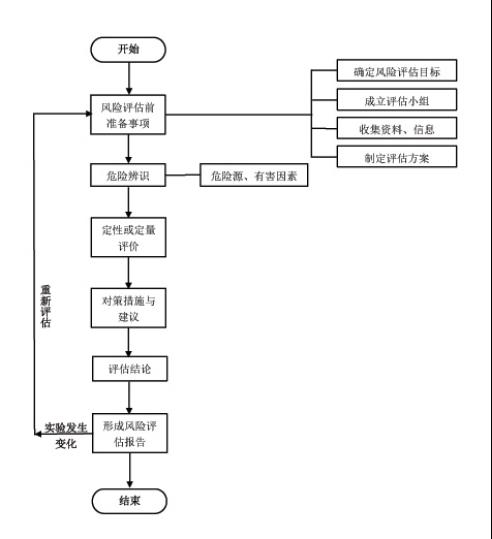


picture1  Risk assessment flow chart


appendixB

 Risk assessment method

 According to the characteristics of experiments and experimental projects, comprehensive analysis, qualitative and quantitative evaluation are generally carried out by using hazard analysis method of working conditions, pre-hazard analysis method, analogy method and checklist analysis method.

(1)Hazard analysis method (LEC)

Hazard analysis method for working conditions (GrahamGinny method is a semi-quantitative risk assessment method for workers working in occupational hazardous environment. The evaluation principle is: the quantitative risk value of operating conditions (D) depends on three factors, (one) the possibility of an accident (L); (2) Frequency of exposure of workers to dangerous working environment (E); (three) The severity of possible consequences in the event of an accident (C)。 Represented by a simplified formula is:D=L×E×C

amongDThe greater the value, the greater the danger of the operation. Danger of working conditionsDSee table for the classification of values.2.

table1  Hazard classification table

Risk score (D)

≥320

≥160319

≥70159

70

criticality

Extremely dangerous, can’t continue to work.

It is highly dangerous and needs immediate rectification.

Significant danger and need to be rectified.

lowerDanger, need attention.

risk level

Major risk

Greater risk

General risk

Low risk

Risk color


LECSee table for the range of the three factors.2, tablethree, tablefour.

table2   L-Accident possibility score

Fractional value

10

six

three

one

0.5

0.2

0.1

Possibility of an accident

Will be completely expected.

considerably

probably

Maybe,

But not often.

Completely unexpected, rarely possible.

It is conceivable that it is rarely possible.

precious few

probably

in fact

impossible

table3   E-Frequency score of exposure to dangerous environment

Fractional valueE

10

six

three

one

0.5

Frequency of exposure to dangerous environment

Continuous exposure

Exposure during working hours every day

Monthly exposure

once

Annual exposure

several times

Very rare

Exposure of

table4   C-Consequence score caused by accident

Fractional valueC

100

40

15

seven

three

one

Consequences of the accident

more than 10 people

die

a few people

die

one person

die

serious

casualties

Be disabled

slight wound

Need ambulance


(2) Pre-hazard analysisway

Pre-hazard analysis (PHA) is a system safety analysis method that makes a macro and general analysis of various risk factors (categories and distributions), occurrence conditions and possible consequences of accidents in the system before an activity (such as an experiment). Its purpose is to find the potential risk factors of the system at an early stage, determine the risk level of the system, and put forward corresponding preventive measures to prevent these risk factors from developing into accidents and avoid thoughtlessness.The losses caused are qualitative evaluation. That is to say, discuss, analyze and determine the dangerous and harmful factors existing in the system, their triggering conditions and phenomena, the causes and events that caused the accident, the accident types, the accident consequences and the danger level, and put forward the safety precautions that should be taken.

(one) Pre-hazard analysis step

 Fully investigate the purpose, process, operating conditions and surrounding environment of the experiment;

 Collect past experience and accidents in similar experiments, judge whether similar situations will occur in the objects to be analyzed, and find out the dangers that can cause material losses and personal injuries;

 Determine the hazard source according to experience, technical diagnosis and other methods;

 Identify the conditions of dangerous transformation and study the trigger conditions of dangerous factors transforming into accidents;

 Carry out risk classification, determine the degree of risk, and find out the dangerous sources that should be controlled emphatically;

 Formulate risk prevention measures.

(2) risk classification

PHAThe result of the analysis is expressed by the risk grade. Danger can be divided into four grades, as shown in table.five.

tablefive  Hazard classification table

grade

criticality

Possible consequences

safe

No casualties and system loss will be caused.

critical

Being on the edge of the accident will not cause casualties, system loss or reduce system performance for the time being, but it should be eliminated or control measures should be taken.

dangerous

Will cause casualties and system losses, to take immediate preventive measures.

disastrous

Catastrophic accidents that cause heavy casualties and serious system damage must be resolutely ruled out and focused on prevention.

(three) evaluation results

Pre-risk assessment analysis adopts the following tabular form (Tablesix) Submit the results.

table6  Hazard pre-analysis table (sample table)

potential

accident

Dangerous and harmful factors

Trigger condition

accident

consequence

danger

grade

preventive measure

Emergency and first aid measures


(four) analysis summary

Through the pre-risk assessment and analysis, the main risks and risk grades of experiments or experimental projects are obtained.

For all kinds of possible dangers and harmful factors, preliminary preventive countermeasures and measures are put forward one by one in the risk pre-analysis table.

(3) analogy method

Through the safety investigation of the same or similar projects as the experimental projects to be evaluated, and the analysis of relevant experimental documents and technical data, it is proposed to evaluate the types and degree of hazards and harmful factors of the experimental projects by analogy, assess the possible hazards and harmful factors, and predict the control effect of the proposed safety protection measures.

(4) Checklist analysis method

According to the national laws, regulations, technical specifications and standards related to occupational safety and health, as well as operating procedures and production safety accident cases, through detailed analysis and research on the experimental items to be evaluated, the inspection units, parts, items, contents and requirements are listed, and a table is compiled to check the compliance one by one to determine the safety problems, defects and potential hazards of the experimental items to be evaluated.

appendixC

Classification and risk level of experiments and experimental projects


1. According to the characteristics of hazardous sources involved in experiments and experimental projects, they can be divided into six categories: chemistry, biology, radiation, electromechanical, special equipment and others from the perspective of safety.

(a) experimental sites (or experimental projects) involving chemical reactions and chemicals belong to the chemical category. The main hazards areExplosive,Flammable and explosive,be poisonedSexual, corrosive and other dangers.chemistryProduct.

(two) experimental sites (or experimental projects) involving microorganisms and experimental animals belong to the biological category. The main hazards are microorganisms (infectious disease pathogens, etc.), animals and other biological factors that endanger the safety of individuals or groups.

(3) Experimental sites (or experimental projects) involving radioactive sources and radiation devices are classified as radiation. The main hazard source is radioactive material.

(four) experimental sites (or experimental items) involving mechanical, electrical, high temperature and high pressure equipment and instruments.Item) belongs to electromechanical category. The main hazards are machining high-speed equipment and high-speed equipment.electricityPressure and high current equipment, excitationOptical equipment, heating equipment, etc.

(five) experimental sites (or experimental projects) involving lifting machinery, boilers and pressure vessels (including gas cylinders) belong to special equipment. The main hazard source is the equipment itself, and the lifting machinery may cause heavy objects falling, crane instability, tilting, squeezing, falling from a height and other hazards; Boiler may cause material failure, explosion or leakage due to overtemperature and overpressure, resulting in mechanical damage, scald and other hazards; The pressure vessel may cause explosion or gas leakage and other hazards due to thermal overpressure, mechanical damage and unqualified pressure reducing valve.

(six) experimental sites (or experimental projects) that do not involve the above-mentioned hazard sources belong to other categories. The main hazard source is the safety risk of electricity and water caused by facilities and equipment such as electricity and water.

Second, according to the hazards used in the experiment.(experimental materials, instruments and equipment, etc.)The degree of danger,And whether a large number of dangerous experimental materials are stored in the experimental site,The experimental safety risk levels of experiments and experimental projects are divided into four levels from high to low: major risk (level I, red), major risk (level II, orange), general risk (level III, yellow) and low risk (level IV, blue).

(a) involving the use ofExplosives, spontaneous combustion,Inflammable and explosivewait forDangerous chemicals with physical hazards, andHighly toxic and easy to make drugs.Easy to explode, narcotics and psychotropic substancesControl chemicals or drugs, etc.Highly pathogenic microorganisms, radioactive sources, etc.; Or a large number of dangerous chemicals or controlled drugs are stored on site than the experimental requirements.It is a first-class safety risk experiment and experimental project.

(two) involving the use of other dangerous chemicals, low pathogenic microorganisms, experimental animals, pressure vessels, laser equipment, strong magnetic equipment, etc., for the second-level safety risk experiments and experimental projects.

(3) It involves the use of hoisting machinery, high-speed equipment, rotary machinery, cold and hot equipment (refrigerators, ovens, muffle furnaces, etc.), high-power charging and discharging devices, high-voltage equipment, etc., and is a three-level safety risk experiment and experimental project.

(4) Experiments or experimental projects not listed in the above three categories are four-level safety risk experiments and experimental projects.

Three, the above division of experimental safety risk level, after the experimental materials, equipment, experimental technology, operation methods, personnel qualifications, environmental conditions,Protective measures, etcAfter the comprehensive risk assessment of factors, if the risk degree increases, it should be adjusted according to the comprehensive assessment results.Experimental safety risk level of experiments and experimental projects.
appendixD Compilation format of safety risk assessment report


××××××Experimental safety risk assessment report

I. Overview of experimental projects

one. Brief introduction of experimental project

2. Purpose of evaluation

three. Evaluation basis

four. Scope of risk assessment

five. Risk assessment method

Second, the experimental process (process) introduction

Third, hazard identification.Identification and analysis

Fourth, qualitative and quantitative evaluation

one. Qualitative and quantitative evaluation

2. assessment result

V. Safety countermeasures and suggestions

one. Put forward targeted safety countermeasures and measures.

2. Supplementary suggestion

VI. Conclusion of Safety Risk Assessment


××××××Experimental safety risk assessment form

First, the basic information of the experiment

Experimental name


Experimental category

Chemistry,Biology,Radiation class,Electromechanical class,Special equipment class,Other classes

project leader


contact number


Laboratory safety

person in charge


contact number


Name of department


Laboratory location


Second, the experimental survey

(Briefly describe the experimental principle, experimental steps, reagents or materials used, equipment, etc., and attach the experimental scheme.)


Third, the dangers involved in the experimentsource

Types of hazard sources

Chemical safety    radiation safety      Special equipment safety      Electromechanical safety    

electricsafe    bio-safety      Laser safety              other      

Fourth,mainHazards or harmful factors

serial number

Hazards or harmful factors

Dangerous characteristics

quantity

Other instructions


(according to the experimental content, from the experimental materials or reagents and instruments to be used./Equipment (including special equipment), experimental operation steps, laboratory environmental conditions and protectionmeasure, education, training and access, emergency plans and drills, as well as rules and regulations, etc., and make a specific list. If the list is large, it can be explained in a separate schedule.)

V. Security risk analysis

1. Is there any risk of explosion, fire, corrosion, poisoning and hazardous waste during the experiment?

(According to the list of dangerous sources, analyze the possible negative effects on personal safety, human health, laboratory environment and surrounding environment during the experiment.)


VI. Protective and emergency measures to be taken


Seven,Risk level of experiments and experimental projects

Major risks (level 1)         Greater risk (level 2)

General risk (level 3)         Low risk (level 4)

Evaluation expert opinion

(The number of experts shall not be less thanthreePeople,When necessaryYou can inviteSafety and emergencyfieldexpertOr experts with similar project experience)


Signature:                                                                                    year    moon    sun             

experimentAnd experimental projectsOpinion of person in charge

Opinion:


Signature:                                                                                    year    moon    sun

Unit opinion

Opinion:


Signature of the person in charge of the unit:                                                                year    moon    sun

Instructions for filling in the form:

1.Please fill in the corresponding column when the laboratory does not involve dangerous sources.without"; When the form is not enough, please add it yourself.

2.This report is made in triplicate, one for the project leader, the secondary unit and the competent business department, and the copy is valid.

riverIssued by the Office of Science and Technology Department of Jiangsu Province on September 13, 2022

Attachment:Notice on printing and distributing guidelines for risk assessment of scientific experiments
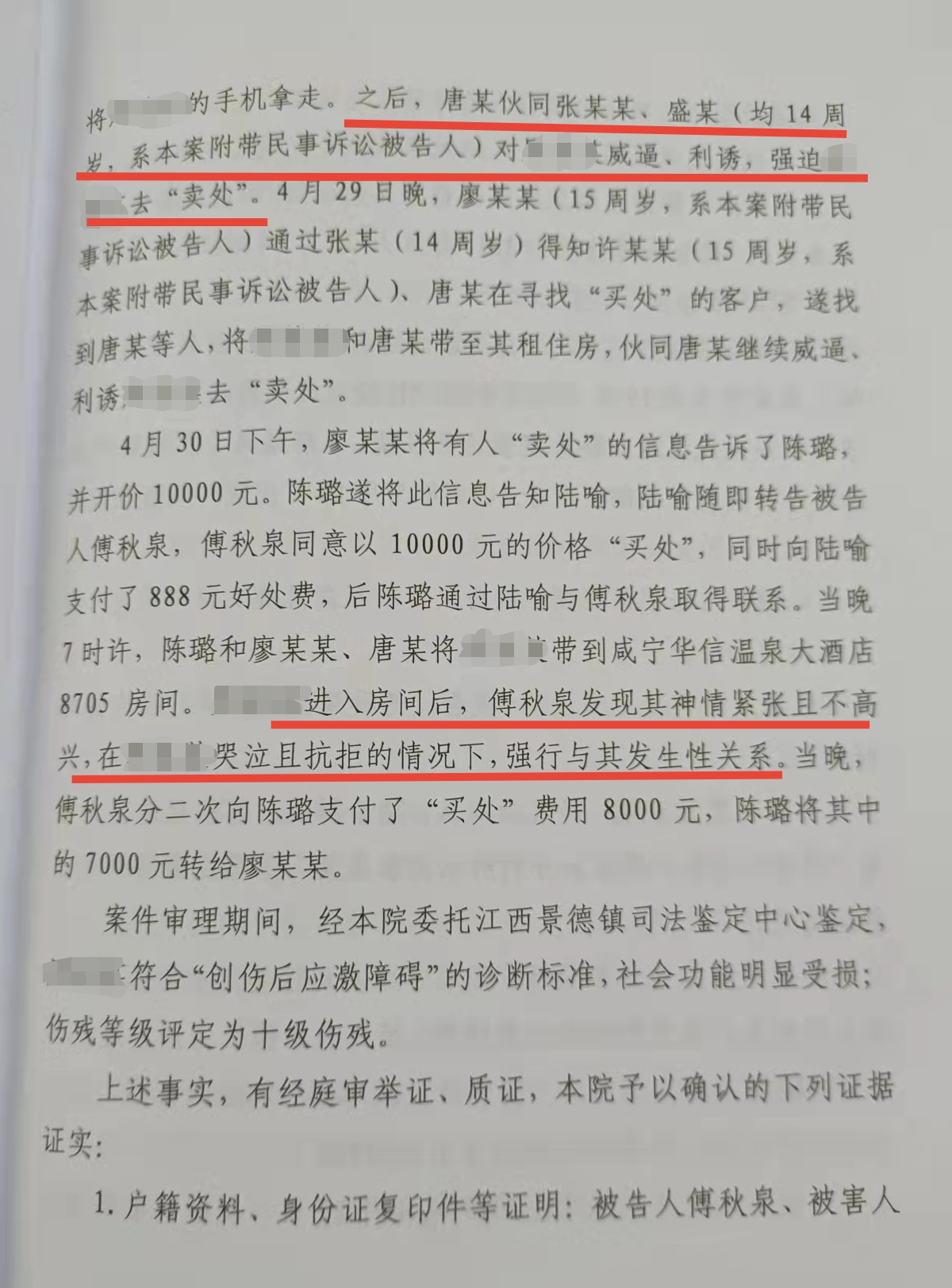
China’s research team first unveiled the mystery of Zika virus replication in the world.

CCTV News:At present, Zika virus is still spreading in parts of South America and Latin America, and there is no effective drug to inhibit the infection of this virus. Recently, the research team of Tianjin University published a paper in the international authoritative academic journal protein and Cell, saying that the mystery of Zika virus replication was uncovered for the first time, which will provide an important basis for developing anti-Zika virus drugs.

According to experts, the scientific community has not found the means to inhibit Zika virus so far, and the important reason is that it is impossible to understand the replication process and mechanism of this virus. Since February this year, the research team of Tianjin University has started a research project on Zika virus, and has achieved important research results recently.

According to Tian Hongliang, School of Life Sciences, Tianjin University:In the process of virus replication, almost all viruses need a protein called helicase. Our research team’s main work is to analyze the three-dimensional spatial structure of Zika virus helicase and the three-dimensional spatial structure of Zika virus helicase recognizing its genome.

Helicase protein

Helicase protein

This protein, called helicase, plays an important role in the first step of Zika virus replication. Because the Zika virus genome exists in a double-stranded state, it is impossible to replicate the gene in this state, so it must be split into two, and the helicase is equivalent to a pair of scissors, which can cut the genome into two pieces and achieve replication, but this pair of scissors has never been exposed before, so the mechanism of virus replication is unknown. The research results of Tianjin University’s research team reveal the three-dimensional image of a single molecule of gyrase, and thus unlock the secret of how Zika virus replicates.

Janet, a professor at the School of Life Sciences, University of Michigan, USA, who has been working on Zika virus research, said that this is crucial to stop the spread of Zika virus from the root and develop drugs against Zika virus.

【 Hazards of Zika virus 】

In 2013 and 2015, during the outbreak of Seca in French Polynesia and Brazil, it was reported that Zika virus disease might cause neurological and autoimmune complications. In the outbreak of Zika in Brazil in 2015, many newborns with microcephaly were found (the ratio of head circumference of newborns to matched children of the same sex and gestational age was lower than the average by more than two standard deviations). From May 2015 to January 2016, it was reported that 4000 pregnant women infected with Zika virus gave birth to microcephaly, which was 20 times higher than that in previous years.

[The Rio Olympics has not been affected by Zika virus so far]

Brazilian Health Minister Castro met with the ambassadors of EU member states here on February 16th, and assured them on behalf of the government that the current outbreak of Zika disease would not affect the Rio Olympic Games this year.

Part of the text comes from: Xinhua News Agency

Add a "new member" to the zero-running car, and a latecomer with material.

Although not excellent, it can also reach the mainstream level of the same level. The following small series will tell you in detail.

Let’s look at the appearance of the zero-run T03 first. The front of the zero-run T03 presents a simple design style, which makes people unforgettable. Coupled with the fashionable headlights, the design took the sports route. The car is equipped with automatic opening and closing, delayed closing and so on. Coming to the side of the car body, the size of the car body is 3620 mm * 1652 mm * 1592 mm. The car adopts deep lines, and the side wall presents an avant-garde design style, which is eye-catching with large-size thick-walled tires. In the rear part, the rear looks very simple, and the taillights look very fashionable and concise.

Coming into the car T03, the front face of T03 looks very fashionable and simple, which reflects the sense of design. The steering wheel design of this car is very comfortable, and it is equipped with functions such as manual adjustment of the steering wheel up and down, which looks a bit more capable. Let’s take a look at the central control. The car is equipped with a touch-sensitive LCD central control screen, which makes the interior style impressive and conforms to the mainstream aesthetics. The dashboard and seats give people a good feeling, too. Let’s take a look. The dashboard design is remarkable and looks simple. The car uses leather seats, which are wrapped in place and have good support and comfort.

The zero-run T03 is 80KW, the total torque is 158N.m, and the maximum speed is 100km/h..

The car is equipped with traction control (ASR/TCS, etc.), Bluetooth /WIFI connection, cruise control, voice control, intelligent key and other configurations, and the configuration performance is relatively good, which improves the convenience of drivers to some extent.

What’s your main impression of this car after reading the whole article? I wonder if you are excited about this car introduced today?