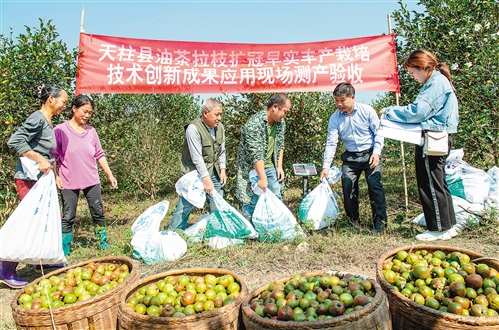
In the oil-tea base of Sanjianqiao Village, Baishi Town, Tianzhu County, Guizhou Province, oil-tea experts are measuring production. Photo by Jin Kewen (Zhongjing Vision)
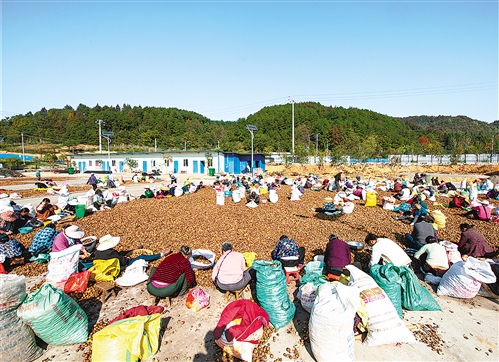
Villagers rummaged through Camellia oleifera fruit in Guizhou Hengshengyuan Company. Photo by Jin Kewen (Zhongjing Vision)
Tianzhu County is the core area for the development of Camellia oleifera industry in Guizhou Province. Camellia oleifera is regarded as the leading industry for poverty alleviation and rural revitalization in the county. Camellia oleifera Office is established, scientific and technological enterprises are introduced, excellent Camellia oleifera varieties are cultivated, and seedling breeding bases and industrial demonstration parks are established, so that the output of Camellia oleifera is greatly improved and the products of Camellia oleifera are more diversified. By accurately docking the market, the sales channels of camellia oleifera products in Tianzhu County are smooth, and camellia oleifera has become a pillar industry for people to get rid of poverty and increase income.
In the warm sunshine of early winter, more than 40 villagers, such as Yang Hanliang and Yang Tengze, from Qizhai Village, Lantian Town, Tianzhu County, Guizhou Province, carried bags and went to the slopes of Xiaochongyin and Chonggunpo in Qizhai to pick camellia oleifera fruit. In just over 20 days, 200,000 Jin of camellia oleifera fruit was harvested and returned to the warehouse.
Camellia oleifera yield increased
"Our camellia oleifera is very scientific from seedling selection to management, so despite the bad weather conditions this year, it has achieved a bumper harvest." Yang Tengze said that under the guidance of Yuan Changxuan, a county expert in camellia oleifera technology, their camellia oleifera was planted on the hillside between 330 meters and 450 meters above sea level, and the soil was yellow and red, which was very suitable for planting camellia oleifera. They chose the right seedlings, and the planted camellia seedlings were Xianglin No.1, No.27, No.97 and No.201 cultivated in the county. These young seedlings grew rapidly, had strong disease resistance and high fruit-bearing rate. They manage scientifically and implement 24-word technical measures of "topping and controlling height, dwarfing and layering, pulling branches and expanding crowns, regulating branch direction, topping and controlling crowns, and cultivating branch groups". The trees are densely spaced, and the branches outside the crowns do not cross each other and receive good light. Their fertilization time is accurate. In the first year, from April to June, furrowing fertilization was carried out with knife stroke, from September to November, holes were expanded to loosen the soil for cultivation, and the open space was cut, irrigated and weeded, and the holes were expanded to loosen the soil and reclaim the trees, all of which were applied with organic fertilizer.
Eight people including Yang Tengze, Yang Hanliang and Yang Qihai planted more than 560 mu of camellia oleifera in 2011, with 65,000 camellia oleifera plants. In 2015, these camellia oleifera trees began to bear fruit, which broke the worry that many people had to plant camellia oleifera for seven or eight years to bear fruit. In that year, they harvested 10,000 kilograms of camellia oleifera fruit. In 2017, despite the drought, they harvested 140,000 Jin of camellia oleifera fruit; In the long-term rain in 2018, they harvested 180,000 Jin of camellia oleifera fruit; It was rainy in April and May this year and dry in June, July and August, but they still harvested more than 200,000 Jin of camellia oleifera. At the same time, 50 villagers in this village and neighboring villages will be employed every year, and the per capita annual income will increase by more than 3,000 yuan.
In the demonstration base of Sanjianqiao Camellia oleifera forest in Baishi town, this year’s harvest season is extremely lively. The mode of "cooperative+base+farmer" is adopted here, and the content of scientific and technological planting is improved, and the oil tea trees Baishi No.4, Xianglin No.1, Xianglin No.16, Xianglin No.27 and Xianglin No.201 are planted. Since 320 mu of Camellia oleifera began to bear fruit in 2015, the output has increased year after year. In 2019, the output of Camellia oleifera fruit was more than 210,000 kilograms. Villager Yang Ping relies on Camellia oleifera forest land to breed ecological chickens. In 2019, there were more than 10,000 ecological chickens under the forest, with an annual income of more than 800,000 yuan. He also led 42 villagers to plant camellia oleifera and raise chickens under camellia oleifera forest to get rid of poverty and get rich.
Product diversification
In Tianzhu Lianshan Immigrant New Area, Guizhou Hengshengyuan 10,000-ton Camellia oleifera fruit processing factory, on rainy days, more than 100 ex situ poverty alleviation relocated households collect Camellia oleifera seeds in underground warehouses; On sunny days, they sort Camellia oleifera seeds in the open-air threshing ground, earning more than 100 yuan per person per day. Behind solving a large number of jobs, it is inseparable from the oil tea processing enterprise Hengshengyuan Company to turn scientific research oil tea into a source of wealth.
Guizhou Hengshengyuan Agricultural Development Co., Ltd. settled in Tianzhu in December 2013, which is a comprehensive joint-stock enterprise integrating cultivation, planting, intensive processing and sales of improved camellia oleifera seeds. "Our company is not satisfied with the traditional method of squeezing crude oil, nor is it satisfied with only processing edible oil." Chen Lianshan, head of the office of Hengshengyuan Company, said that in recent years, the company introduced scientific research talents and advanced equipment, developed products such as camellia oil, camellia oil essential oil and camellia seed shampoo by physical cold pressing technology, and stepped up research and development of biological herbicides for camellia shells, which was favored by the market. The 10,000-ton Camellia oleifera fruit processing project started construction in 2018 and was completed and put into operation in November 2019. It can process 18,000 tons of Camellia oleifera fruit annually, producing 1,500 tons of camellia oil and 1.2 million bottles of essential oil. The company bought a large number of Camellia oleifera fruits from Camellia oleifera growers in the county, which solved the sales problem and benefited more than 30 thousand people.
In the Camellia oleifera processing factory of Guizhou Yongxing Technology Development Company, the workers control the machine, and the Camellia oleifera fruit is dried, sorted, pressed and produced in one go.
In order to solve the problem that tea seeds are mildewed due to insufficient drying heat during the harvesting period of camellia oleifera, Yongxing Technology Company added a "hot air explosion" camellia oleifera seed shell separation production line in 2019, which can process 18 tons of fresh camellia oleifera every day, changing the inefficient production status that the drying and cracking of camellia oleifera depend on the sky and the seed selection depends on people. At present, the company’s "hot air explosion pu" camellia seed shell separation production line implements three shifts, with 18 fixed employees and a per capita monthly income of more than 3,000 yuan. The company bought 2,400 tons of fresh fruit of Camellia oleifera, which not only solved the problem of selling fruit for Camellia oleifera growers in this county, but also solved the problem of selling fruit for Camellia oleifera growers in surrounding counties such as Sansui and Cengong. At present, the company squeezes 3,000 tons of crude oil, 500 tons of refined oil and 1 ton of tea oil cosmetic oil per day.
Smooth sales channels
Tianzhu vigorously promoted Camellia oleifera products through the media at all levels of the central government, provinces and States, and the popularity of Camellia oleifera products increased year by year. Relying on agricultural supermarket docking, agricultural school docking, agricultural enterprise docking and other ways to improve the share of Camellia oleifera products in the national market. Take advantage of the cooperation between the east and the west in poverty alleviation and the opportunity of "Guizhou goods coming out of the mountain" to sign an order contract. Develop agricultural products e-commerce, Wechat business and other cloud service sales platforms to promote the export of Camellia oleifera. At present, Tianzhu’s camellia products are in short supply.
Camellia oleifera has become a pillar industry for people in Tianzhu County to get rid of poverty and increase income. "Tianzhu County is the core area for the development of Camellia oleifera industry in Guizhou Province. The county regards Camellia oleifera as the leading industry to help poverty alleviation and rural revitalization." Yuan Changxuan said that Tianzhu County Camellia Office was established in 2010, and three excellent clones of Camellia oleifera, such as Baishi No.4, were selected as the first to pass the provincial forest seed identification, creating a breeding base for thousands of seedlings, creating Tianzhu County Camellia oleifera Industry Demonstration Park and Qifeng Camellia Oleifera Ecological Park, and registering the trademarks of Sanxingyan, Plateau Star, Yimin and Guizhou Red Camellia Oleifera. "One County, One Industry" Camellia oleifera free range chicken "Feng 99" won the gold medal in the 11th International Forest Expo. "Tianzhu Tea Oil" was registered and protected by the national geographical indications of agricultural products in September 2019. Tianzhu has been identified as a key county for the development of Camellia oleifera, a national demonstration base for Camellia oleifera science and technology, and a demonstration county for economic forest base in Guizhou Province.
At present, Tianzhu Camellia oleifera has a total area of 300,000 mu and can produce more than 8,900 tons of tea seeds, which has driven 156,000 people to increase their income.