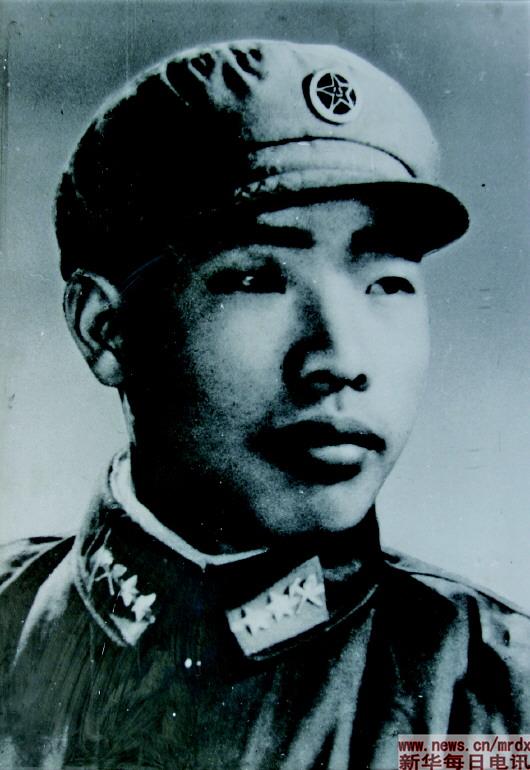
▲ Wang Jie’s photos before his death. Xinhua news agency issued an information piece
In the Wang Jie Martyrs Memorial Hall in Pizhou City, Jiangsu Province, there is a pavilion with a strange shape, with cornices and horns, a double-layer hexagonal glazed tile shape, surrounded by pines. What is strange is that it has 12 columns.
This pavilion was built at the sacrifice of Wang Jie. On July 14th, 1965, Wang Jie, the squad leader of an engineering company of jinan military area command Armored Forces, was caught in an accidental explosion of explosives while organizing militia training. At a critical juncture, 23-year-old Wang Jie threw himself at the explosive charge and covered the 12 militiamen present, but his life was always fixed at the age of 23. Those 12 pillars represent the 12 people saved by Wang Jie.
Wang Jie was a great communist fighter who was once as famous as Lei Feng, and he was also one of the 100 people who moved China since the founding of New China. President Mao Zedong wrote an inscription for him, "I agree with this slogan, that is, one is not afraid of suffering, and the other is not afraid of death".
On December 13th, 2017, Chairman of the Supreme Leader came to the company where Wang Jie, a brigade of the 71st Group Army stationed in Xuzhou, Jiangsu, lived before his death. Before the bloody clothes and pen fragments left by Wang Jie at the time of his sacrifice, the Supreme Leader learned more about Wang Jie’s feat of sacrificing himself to save others. The Supreme Leader said with emotion: "I knew the story of Wang Jie when I was a child, and Wang Jie was my hero!"
Shortly after the Supreme Leader became the chairman of the Central Military Commission, he clearly pointed out that soldiers should be bloody, and blood is the fighting spirit, and the core is the spirit of not being afraid of suffering and not being afraid of death. The supreme leader has repeatedly stressed that the fighting spirit of not being afraid of hardship and not being afraid of death can not be lost at any time.
Wang Li, director of the Wang Jie Martyrs Memorial Hall, told reporters, "Unfortunately, in the past few years, because of less publicity, there were too few young people who knew about Wang Jie!"
Even at the beginning, Wang Jie was almost buried or even misunderstood. After Wang Jie died, the local people held a memorial service for him on July 16th, and two months later, his army held a grand memorial service for him. More than 50 years have passed, and we re-entered the history. With the help of many exhibitions in the Wang Jie Martyrs Memorial Hall, we visited the old militia of the "Landmine Class" in those days, and felt the truth about whether a sacrificed soldier was a hero or a responsible person at that time, deeply moved by the heroic integrity!
Unexpected explosion, Wang Jie saves lives and sacrifices.
Wang Jie was born in Jinxiang County, Shandong Province in 1942. After he joined the army in August 1961, he was rated as an excellent soldier every year, won the third class merit twice, and was rated as a model Communist Youth League member and a first-class blasting expert.
In June 1965, Wang Jie’s engineering battalion went camping in Zhanglou Commune, Pixian County, and conducted swimming training in the canal. At the end of June, the leaders of the Party Committee and the People’s Armed Forces Department of Zhanglou Commune found the engineering barracks and requested to send coaches to help train the commune militia mine class.
The battalion commander and instructor decided to send Wang Jie as the coach. From then on, Wang Jie got up early every day, went to the militia training ground on time at 5 o’clock to give lessons to the militia, and returned to the army for swimming training at 8 o’clock.
On July 14th, Wang Jie gave a class to the militia on the topic of "trip-type anti-infantry mine application". This kind of mine has no fuse and needs to explode instantly to destroy the enemy.
The old man Li Yanqing, the squad leader in situ, recalled that Wang Jie had very high requirements for their training, because "the training ground is the battlefield". How to dig a mine pit on your knees and lying down, and how to keep silent and observe the enemy’s situation when digging a mine pit, etc., are carried out in full accordance with the requirements of actual combat. Wang Jie chose the teaching place that day, which is the crossroads where mines need to be buried in actual combat.
"We use land mines. We wrap four detonators with cement paper. Each detonator is filled with 225 explosives, connected to a detonating device, and buried in the ground, which becomes a mine." Li Yanqing said.
Li Yanqing was located in the left front of Wang Jie, less than 1 meter away from Wang Jie. Eleven other militiamen also gathered around Wang Jie, squatting or standing, absorbed.
Wang Jie first explained the essentials of real explosion, and after finishing the training course, he began to do real explosion demonstration. He tied up the explosive charge, connected the detonator and the fuse together, and everything went smoothly. He explained to the 12 people in a circle: "What I just did was the actual explosion connection step of the explosive charge. After doing this, the next step is to pull the fire plug of the fire tube and explode immediately … "
While Wang Jie was giving a lecture, an accident happened: white smoke emitted from the soil layer where the explosive charge was buried, and sparks splashed. As Li Yanqing and others were terrified, Wang Jie had already jumped up …
Li Yanqing just subconsciously covered her face with her hands, and then she was stunned and her leg was injured. Wu Buliang, who was 18 years old, squatted in the left rear of Wang Jie, closer to the explosion point. His right half of the skin was all torn by the explosion and was also stunned by the explosion …
When they woke up, they saw the militia Luo Hanrui holding his right leg and crying: "My leg is gone, Teacher Wang is gone …"
Luo Hanrui stood on the right side of Wu Buliang, close behind Wang Jie. Afterwards, they analyzed that when Wang Jie jumped on the mine, the explosion shock wave passed through the gap between Wang Jie’s legs and broke Luo Hanrui’s right leg.
Wang Jie was blown to pieces. But all the 12 militiamen around him survived. Luo Hanrui was the most seriously injured, resulting in amputation of his right leg.
The officers and men of the army quickly came to protect the scene, rescue the wounded and collect Wang Jie’s flesh and blood …
The battalion commander and instructor of the engineering battalion, the Minister of Armed Forces of Pixian County and the political commissar all rushed to the scene. After listening to the introduction of 12 people present at that time, they reported Wang Jie’s sacrifice to the division party committee.
Why does the flame tube spontaneously ignite?
The Party Committee of the Division decided to send Liu Deyi, director of the Political Department of the Division, to lead the investigation team to Wang Jie’s camp, company and Zhanglou commune to find out what had happened. Liu Deyi and others went to the engineering barracks and Zhanglou commune and were moved by Wang Jie’s actions. They decided to draw up the report materials according to the martyrs who died in the line of duty.
However, when drafting the investigation report, the investigation team encountered a problem: why did the ignition tube spontaneously ignite? Is it the spontaneous combustion of the ignition tube or the explosion caused by Wang Jie’s misoperation? This issue is directly related to the nature of Wang Jie’s sacrifice. If this question is not clarified and answered in detail, the submitted materials will also be returned because of doubts.
Li Yanqing and others were separately investigated by the investigation team. They recalled every movement and step of Wang Jie’s on-site operation, which proved that Wang Jie’s operation was completely correct and there was no problem of improper operation.
Self-ignition of the fire hose is still a problem that puzzles everyone, because such things are really rare. At the enlarged meeting of the battalion party Committee attended by all members of the investigation team, some people suggested that "unless someone tampered with the fire hose in advance", and some even thought it was "a man-made vicious accident".
The investigation team conducted an in-depth investigation with some cadres of the People’s Armed Forces Department of Pixian County and Zhanglou Commune on the situation a few days before Wang Jie’s sacrifice, especially whether anyone handled weapons and equipment or contacted explosives on that day, and repeatedly investigated the situation, thus eliminating the doubt that "there were class enemies cheating".
At this time, the division party Committee called and urged the investigation team to come up with the investigation results as soon as possible. Liu Deyi had to synthesize the investigation and different opinions on the determination of Wang Jie’s sacrificial nature, and write a report outline.
According to the investigation report, at that time, only Wang Jie himself was exposed to explosive equipment and materials, and the possibility of "class enemy destruction" was ruled out. At the enlarged meeting of the Party Committee of the battalion, many people suggested that it was impossible for the torch to spontaneously ignite, so that only Wang Jie could make mistakes. After repeated research, the Party Committee of the Division had to define Wang Jie’s sacrifice as "a fatal accident caused by violation of operating regulations" according to the telephone report of the investigation team. In this way, Wang Jie can not only be regarded as a hero, but also be regarded as a mistake and given severe punishment.
It was midsummer, and the weather was hot, so Wang Jie’s body collected by local cadres and masses and army comrades could not be preserved. The militiamen of the mine squad began to make coffins for Wang Jie. At the strong demand of local cadres and masses, the army decided to bury Wang Jie in the place where he died.
On the morning of July 16th, the Party Committee of Zhanglou Commune and the Party Committee of Engineering Battalion jointly held a burial ceremony. About 1,500 people, men, women and children took part in the mourning in the rain, and Ding Ruguang, secretary of the commune, led the way in front of the coffin. They buried Wang Jie according to local customs, and the people in the surrounding villages came from all directions, holding flowers and paper banners, with tears streaming down their faces.
As the Party Committee of the Division has characterized the explosion as "a fatal accident caused by illegal operation regulations", the memorial service for Wang Jie held in the engineering barracks that afternoon was completely different from the situation of the local funeral for Wang Jie. At the meeting, Wang Jie’s deeds were not introduced, but more like a briefing. At the end of the eulogy, the camp instructor said: "Wang Jie, as a monitor, a model of Lei Feng and a first-class technical expert, caused a vicious accident that should not have happened, causing serious losses to the army building and the masses …"
This memorial service puzzled all the officers and men in the battalion. After the memorial service, everyone talked about it: In any case, in order to cover the 12 people present, Wang Jie jumped on the explosive charge and saved other people’s lives with his own life, which is beyond the ordinary people’s ability. This action itself shows that Wang Jie is great. He is not a hero, who else can be a hero?
Wang Jie’s comrades-in-arms questioned the conclusion of "violation of operating regulations". They said: In the company, Wang Jie has the highest level of blasting technology, a strong sense of responsibility and a very careful heart. He is the most reassuring real blaster in the company. How can he "violate the operating regulations"?
Accidental discovery of Wang Jie’s diary
Liu Deyi, director of the Division’s Political Department, heard the different opinions of Wang Jie comrades-in-arms and local people on the conclusion of the Division’s Party Committee in Zhanglou, and brought them back to the Division. He stressed at the party committee meeting: We must be responsible for Wang Jie in the grave, and we must not be hasty!
He made a request for reexamination to the Party Committee of the Division, and the Party Committee agreed to re-establish an investigation team to investigate the cause of Wang Jie’s sacrifice. Liu Deyi led a team to visit the militia mine squad and Zhanglou people in detail. The 12 militiamen rescued by Wang Jie strongly demanded the establishment of Wang Jie’s heroic behavior; The people of Zhanglou Commune confided to the investigation team what Wang Jie had done for them.
Liu Deyi was moved again, and initially realized that there must be a deep "hidden story" when Wang Jie pounced on the explosion point.
The investigation team went to the company where Wang Jie lived before his death to recheck his relics. Unexpectedly, 23 diaries were found under Wang Jie’s pillow, in his suitcase and in the drawer of his desk. This is Wang Jie’s most intimate thing, and he never shows it to others. Therefore, it is also a record of his true thoughts.
"The happiest thing in a person’s life is to obey the needs of the motherland …" This is Wang Jie’s diary before he joined the army.
"People alive how to learn to be? What kind of person are you? By studying "Serving the People", I deeply realized that being a man is to be a Lei Feng-style person with communist morality and serve the people wholeheartedly. " (August 3, 1963)
“什么是理想?革命到底就是理想。什么是前途?革命事业就是前途。什么是幸福?为人民服务就是幸福。”(1964年7月28日)
“我们要一不怕苦,二不怕死,做一个大无畏的人。”(1965年5月1日)
“李玉和说:‘共产党员,怕死就不要干革命!’……只要革命需要,我一定像李玉和那样视死如归,不怕牺牲,直到生命的最后一秒钟。”(1965年6月28日)
随着不断翻阅日记,王杰的可贵精神跃然纸上。23本日记看完后,刘德一的双眼红了——如此高尚、纯粹的战士,怎么会制造事故破坏部队建设呢?
刘德一在师部党委会上捧出王杰的23本日记。常委们相互传阅,他们同样被王杰的精神所感动,决定将23本日记迅速送济南军区装甲兵党委。
装甲兵常委会各常委相互传阅王杰日记后,当即拍板:一是将王杰日记报送中央;二是请有关专家对事故进行评估。
炸药和爆破专家的现场报告
在邳州王杰烈士纪念馆内,陈列着一份《来自现场的调查报告》。报告显示,专家组到民兵训练的现场进行勘察拍照后,分别找12名参训人员逐一调查,绘制出当时王杰与12人的各自位置。为了查证王杰在爆炸瞬间扑向炸点的情况,专家组决定进行现场实爆试验。
In early August, Tian Yongtai, chief of the division’s engineering department, organized a real explosion. Ji Jiaxiang, who has rich blasting experience, has been in charge of military training for a long time. The training team of engineers and coaches in the division was once the instructor of Wang Jie.
After Ji Jiaxiang connected the detonator with a fire hose, he knelt on one leg and squatted on the other according to Wang Jie’s original operation procedure and posture described by the militia. He rolled back after pulling the torch away, and the detonator exploded with a bang, leaving Ji Jiaxiang safe and sound.
The actual explosion shows that Wang Jie, as a first-class blasting expert, can save himself when he finds that the explosive is about to explode, as long as he leans back quickly and avoids the maximum killing angle of 45 degrees formed by the explosion. But he gave up self-help, resolutely jumped on the bombing point and gave his precious life.
The data obtained from the field measurement and investigation by the expert group verified that the shock wave formed by the explosion threw Wang Jie more than one person above the ground, and his body was thrown behind his working position, with his head 2.1 meters away from the explosion point and his feet 3.7 meters away from the explosion point. This is caused by his body jumping forward, focusing on the explosion point and being thrown-if he keeps his original posture unchanged, he will only be thrown backwards by the shock wave, and it is impossible to throw it 2 to 3 meters, and it is impossible to turn his body upside down. The five slightly injured militiamen all had broken bones of Wang Jie, which further proved that Wang Jie covered the bombing point with his own body …
Experts also conducted more than 30 tests with similar explosive materials used in Wang Jie, and finally reached the following conclusions: 1. The ignition tube used in Wang Jie at that time was out of control, and the ignition tube suddenly spontaneously ignited, so it was too late to take any remedial measures, and the explosive charge would explode in just a few seconds. The fuse tube is out of date, which can only be found when the gunpowder expert carries out physical inspection. As a professional in blasting operation, Wang Jie is difficult to find; Second, at the scene of the incident, from the position of Wang Jie, at the moment before the explosion of the explosive charge, as long as he leans back, he can completely save his life.
A memorial service attended by 7000 people.
The expert’s appraisal not only overthrew the previous conclusion of "improper operation" and "violation of operation regulations", but also proved by irrefutable facts that Wang Jie did not hesitate to sacrifice his real hero in order to save others.
Jinan military area command Armored Forces Party Committee feeds back the expert appraisal conclusion to the Division Party Committee. The Party Committee of the Division met again, and on the basis of confirming Wang Jie as a revolutionary martyr, it ratified him as the official party member of the Communist Party of China. At the same time, it was decided that a memorial meeting for Wang Jie would be held under the auspices of the Party Committee of the Division.
On September 16th, 1965, jinan military area command held a grand memorial meeting for Wang Jie. Jinan military area command and more than 7,000 cadres, people and soldiers from Shandong, Jiangsu, Xuzhou, Xuzhou Army Division, Pixian and Jinxiang counties attended the memorial service. Xu Guangda, commander of armored forces, and Huang Zhiyong, political commissar, presented elegiac couplets: "Serve the people wholeheartedly without selfish interests, and be fearless of the true qualities of the people’s heroes in times of crisis".
All the militia of the mine class attended the memorial service, and Li Yanqing spoke at the meeting on behalf of the militia of the mine class. "I still remember the main content of the speech at that time. The first part was to reproduce Wang Jie’s heroic act of rushing to the bombing point to protect the militia. The second part was to make a statement that he would take over Wang Jie’s gun and continue his unfinished business."
Later, Wang Jie’s deeds spread in a wider range. In the fourth quarter of 1965 alone, more than 1,300 reports related to Wang Jie were published by major newspapers and radio stations in China. Among them, on October 30th and 31st, People’s Daily, People’s Liberation Army Daily and china national radio respectively published and broadcasted excerpts from Wang Jie’s diary, and Xinhua News Agency reporters and People’s Liberation Army Daily reporters jointly published a long newsletter "Ode to Revolutionary Youth". On November 8th, People’s Daily published an editorial entitled "One is not afraid of hardship, and the other is not afraid of death-learning from the lofty spirit of Comrade Wang Jie’s dedication to the revolution" …
Wu Buliang, who is 71 years old this year, recovered in the hospital for more than 20 days, and the doctor took out a small bone from his wound. "Luo Hanrui leg was blown off, no debris. That bone must belong to Teacher Wang … "Wu Buliang said.
Today, Wu Buliang enjoys family happiness at home, with two sons, three grandchildren and one granddaughter. "Now life is very good and relatively rich." Every time he passes by the Wang Jie Martyrs Memorial Hall, he is filled with emotion: "Without Teacher Wang, there would be no me now."
"One is not afraid of suffering, and the other is not afraid of death."
"Wang Jie not only wrote in his diary that he was not afraid of suffering and death, but also proved that he was not afraid of suffering and death with his last sacrifice. In his daily life, he has always been not afraid of suffering and death, and he is an amazing person who is consistent in words and deeds!" Wang Li, director of Wang Jie Memorial Hall, said excitedly that during the construction in Yimeng Mountain area, sudden flash floods swept away the materials, and he rushed to the rescue without hesitation; Climbing dangerous roads and drilling caves, he always takes risks and rushes ahead; In construction blasting, he always takes risks to charge and shoot first. Sometimes there was a squib, and he rushed forward to eliminate it.
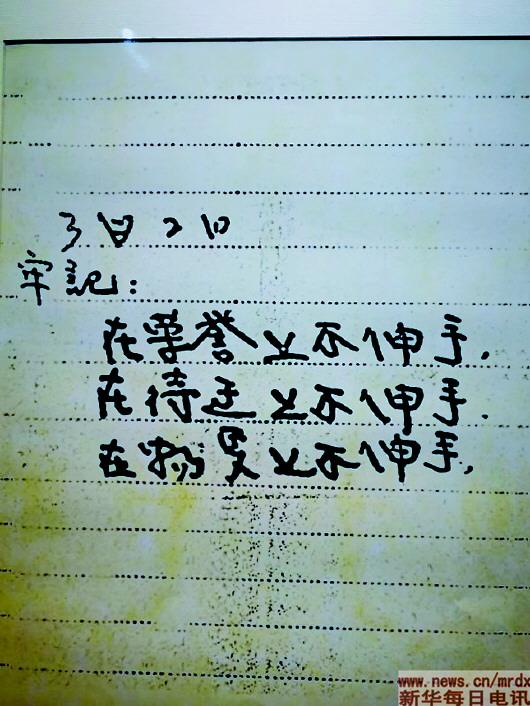
As for the usual good deeds, it is even more numerous! In his diary on February 19, 1964, he wrote: "In order to complete the national defense construction, I am not afraid of breaking into pieces. Now it is bitter for thousands of people not to suffer, and I can bear any kind of suffering. " In his diary on March 3, 1964, he wrote: "Remember: don’t reach out for honor, don’t reach out for treatment, and don’t reach out for material things." He was named "Five Good Soldiers" for three consecutive years, awarded the title of "Model Communist Youth League Member" and "First-class Technical Expert", and won the third-class merit twice.
Wang Jie is also a highly self-disciplined person who keeps learning from Si Qi. The 100,000-word diary he wrote down during his four years as a soldier is full of reverence for advanced figures and strict anatomy of himself. Once, when he learned that he had to train for emergency assembly, he made preparations the night before, and got up half an hour early the next day to wait, grabbing the first place. Afterwards, he realized that this was a fraud, so he took the initiative to look for the platoon leader to review and wrote down in his diary: "The first one that is not allowed. It is disgraceful to get such praise. In the future, I must treat honor correctly and be an unsung hero. " Once, he reflected in his diary that he "collectively watched movies to find a good place, took a bath to find a good place, and always found a good tool for work." Say, "It’s so useless to put’ I’ first everywhere."
Of course, Wang Jie is not an out-of-touch superhero with no interest in life. After work and study, he also has his own hobbies. In Wang Jie Martyrs Memorial Hall in Pizhou, there are musical instruments (erhu and flute), stamp albums and enlarged copies of diaries used by Wang Jie. Obviously, reading and keeping a diary is Wang Jie’s favorite hobby. Wang Jie’s 23 diaries, with more than 100,000 words, faithfully recorded his mental journey from enlistment to sacrifice, and frequently flashed the sparks of Wang Jie’s thoughts.
Later, people summed up Wang Jie’s spirit as "one heart for the revolution, two fears (one is not afraid of hardship, the other is not afraid of death), three does not reach out (not reaching out in honor, treatment and material matters), and four questions (what is ideal? Revolution is an ideal after all; What is the future? The revolutionary cause is the future; What is happiness? Serving the people is happiness; What is pain? The most painful thing for people is to lose people’s trust and the opportunity to work for them. )”
The spring of telling the story of Wang Jie is coming again.
From the day Wang Jie died, the people of Pizhou (formerly Pixian) never forgot this hero. In this land where he gave his precious life, "Wang Jie" is no longer a simple name, but a kind of spirit and a symbol of faith. It advances with the times and becomes a "living teaching material" for the people in party member, Pizhou, inspiring local cadres and mass officials to start businesses, which continues to this day.
In order to continue to study the spirit of Wang Jie, Pixian County Committee established the tomb of Wang Jie Martyrs in Wang Jie on March 10th, 1966. In 2009, it was approved by the State Council as "National Key Martyrs Memorial Building Protection Unit". In 2012, Pizhou City upgraded and rebuilt the cemetery and memorial hall. Wang Jie’s "Zhanglou Militia Mine Class" was named "Wang Jie Militia Class" by Jiangsu Military Region in 1985. The resident primary and secondary schools were named "Wang Jie Middle School" and "Wang Jie Primary School" respectively, which encouraged young people to develop in an all-round way and become small descendants of Wang Jie.
In Pizhou, the activities of preaching Wang Jie’s deeds and carrying forward Wang Jie’s spirit have never stopped. After entering the new century, it is even more important to carry forward the spirit of Wang Jie as a powerful driving force to boost the spirit of cadres and improve their work style. The Municipal Party Committee regards Wang Jie Martyrs Cemetery and Martyrs Memorial Hall as bases for education and mobilization of cadres. Every year, it organizes cadres at or above the departmental level and four teams in the city to pay homage to the cemetery, remember the heroes and accept the baptism of heroic spirit.
Li Yanqing, one of the 12 militiamen, was killed by an accidental explosion in May 1973 when she was clearing a female militiaman’s dumb mines. He insisted on learning from Wang Jie and preaching the spirit of Wang Jie, and was known as "Wang Jie alive and Paul of the present age". Li Yanqing, 78, has given more than 3,000 speeches so far, with an audience of more than 2.1 million.
Chen Jing, secretary of Pizhou Municipal Party Committee, and others believe that Wang Jie spirit is especially needed to promote the great struggle in the new era. Chen Jing said that the Communist party member, as a pioneer in promoting the development of the new era, should be able to see it at ordinary times, be able to rush out at critical moments, and be able to get out at times of crisis, like Comrade Wang Jie, and have the political consciousness of sacrificing and dedicating to the cause of the party and the people at any time.
"The spring of telling the story of Wang Jie is coming again." Wang Li said, "Although Wang Jie’s life is only a short period of 23 years, he has lived a wonderful life, that is, from the current fashionable perspective, young Wang Jie represents positive, optimistic and loyal to his duties, and also conforms to the spirit of the times respected by many young people. Telling the story of Wang Jie well should be welcomed by young people. His revolutionary spirit of "not afraid of hardship, not afraid of death" and "not reaching out" is not only a valuable asset of the whole party and army, but also a powerful driving force to inspire the people of the whole country to work hard. " (Reporter Zhu Xudong, Li Can, Chen Gang)