
Interface journalist |
Interface news editor | Jiang Yiman
"Shuffle is inevitable, the only difference is the strength."
"Out of the water, beauty dying. The brokerage research institute has a sense of decline. "
"There are too many changes, and it is too fast. After seeing a news for two days, another research institute has to change people."
"Some people jump ship for better opportunities; Others are forced to leave to find new opportunities. "
In the face of the recent news of personnel changes from a number of brokerage research institutes, people in the industry have issued various sighs. These changesIn China, the management turnover of brokerage research institutes has increased significantly, among which there are many changes in industry benchmark figures. At the same time, the frequent job-hopping of star analysts attracts people’s attention, and it is not uncommon to take the original team "group" to a new owner.
In addition, ordinary analysts are also surging silently in this wave of personnel turmoil.
The continuous personnel adjustment has made the atmosphere of the seller’s circle, which was already caught in the dilemma of commission reduction, layoffs and declining income, more and more tense. Frequent personnel changes, why did it happen at this time?How will the pattern of seller’s research institute evolve in the future?
Seller’s personnel speed up the flow, and become the industry benchmark.Farewell institute
"The flow of talents is increasing. Under the background of the industry of commission reduction, some contradictions will indeed be re-exposed." Recently, a director of the brokerage research institute told the interface news.
Since the beginning of this year, brokersThe personnel changes in the institute have increased significantly. According to the data of China Securities Association, there were 50 changes in analyst information in February alone. Among them, the brokerage research instituteThe change of the director is particularly interesting.
In February, Li Junsong ceased to be the director of the Capital Securities Research Institute, and Wei Zhichao, the chief economist, became the head of the company’s research and development department, and now he has presided over the work of the department.
It is worth noting that in the recent frequent changes in the management of the seller,There are many industry benchmarking figures.
On March 1st, Guotai Junan Institute held a conference, at which it was announced that Huang Yanming would no longer serve as the director of the Institute, but be the dean of Guotai Junan Finance College, a member of the Wealth Committee and the chief strategy officer.
Huang Yanming is known as the "general teacher of A-share research" in the industry and has been the director of Guotai Junan Research Institute for more than ten years. heThe self-created "three flowers" theory and the "2+1" thinking of securities research also have a wider influence in the industry.
It is reported that the School of Finance is mainly responsible for all kinds of training within the company, especially for investment training. It can be seen that Huang Yanming bid farewell to the Institute and embarked on it.The road of "turning from outside to inside"
In the same month, Zhou Liqian, former director of Hua Fu Securities Research Institute, stepped down.As a member of the Party Committee of Xingyin Growth Capital Management Co., Ltd.
At the same time as the director changes, star analysts are also frequently flowing.
In addition, Dai Chang, the chief automobile officer of Industrial Securities Research Institute, took the post of deputy director and chief automobile officer of Xinguohai Securities.
It is worth noting that the phenomenon of analysts’ "group" job-hopping occurs from time to time. Guohai Securities Research Institute, which just entered the "100 million yuan club" last year, recently experienced a collective job-hopping: Sheng Changsheng, Sun Bowen, Peng Qi and Jing Danyang, the former building materials construction team of Guohai Securities Research Institute, joined Hualong Securities Research Institute, Sheng Changsheng served as the director of the institute, and Sun Bowen planned to serve as the assistant to the director; Yang Yang, chief analyst of Guohai Securities Public Utilities and Small and Medium-sized Team, joined the company and plans to be the deputy director.
Interface news query on the website of China Securities Industry Association found that the practice registration information of many former chief analysts of changjiang securities Research Institute has changed, mainly including Bao Chengchao, former chief strategist of changjiang securities, Gao Deng, former chief analyst of automobile industry, Guan Quansen, former chief social service analyst Gao Xu, and former military industry analyst Wu Shuang.
Regarding the phenomenon of analysts’ group job-hopping, insiders said: "Under the light asset model, the competition of brokerage research institutes is manifested in the competition of talents. In the field of seller research, star analysts have significant influence. However, the alternation of old and new teams often takes a lot of time and energy and needs to be re-run-in. This has also led some analyst teams to choose to leave, because cooperation in familiar teams usually gets twice the result with half the effort. "
"In the field of research and general analysis, leaders and analysts will go through the process of selection and being selected. The strong can be retained, while those with insufficient adaptability face elimination. This is a long-standing law in this industry. " A brokerage chief said.
The analyst’s change is undercurrent, and some pressure is inevitable.
"People who have finished leaving and joining are usually paid more attention, while those who are looking for opportunities are surging in the dark." A director of a medium-sized brokerage research institute revealed to the interface news.
He said: "From years ago to now, I have been talking and interviewing in various ways. Some people leave their jobs voluntarily in order to find better opportunities; Others were forced to leave to find new opportunities because of their poor performance in the original company. "
"At present, the number of brokerage research institutes is continuing to be streamlined, and colleagues have been laid off and their salaries have been reduced. Everyone is under great psychological pressure." Some brokerage analysts said.
Interface news learned that the market is not good and the competition is becoming more and more fierce, and the brokerage research institute is under pressure, and this pressure is constantly transmitted to employees.
"The market is not good, and various brokerage research institutes are studying the end elimination scheme. Some head brokers have started to try out similar schemes. If the assignment is not up to standard, the company will dismiss or transfer posts on the grounds of’ incompetence’ or’ poor performance’. " A brokerage chief told the interface news.
He said that the company has to make an internal defense for employees with less than 1% of the distribution points, so it is usually under great pressure.
The so-called "distribution system",It refers to an assessment mechanism of securities investment consulting services provided by the buyer’s institution to securities firm researchers. Whoever has valuable research will get higher points, and the brokerage will get higher commission.The main source of income for domestic brokerage research institutes is Public Offering of Fund’s sub-warehouse commission.
Relevant people commented: "The situation of Guosheng may not be a case in the industry, and more radical small institutions or platforms may tend to adopt this approach."
"When the industry is facing difficulties, business areas such as brokerage, self-management and investment banking will shrink. In the ecosystem of securities firms, research institutes are not the main profit-creating departments, and the research institutes of domestic securities firms are usually in a state of breakeven, and the operating costs are relatively high. Therefore, when the market is not good, it is inevitable to make post adjustments. " Director of Hua Zhongyi Medium-sized Brokerage Research Institute told the interface news.
The sell studies that reduction of "cake",employee"Supply exceeds demand"
Commission reduction and fee reduction are regarded as catalysts for the turmoil of industry personnel.
"At the moment, the seller’s personnel are loose and come to a peak. Commission reduction is the core reason, and the original profit model under strong supervision has begun to work. In addition, another important factor is the long-term downturn in the market. Brokers have no money to burn, and researchers must bear the brunt. " Some practitioners from the brokerage research institute told the interface news.
A senior analyst told Interface News: "The staff of the Institute has changed greatly, mainly due to lowering the commission rate of securities trading in Public Offering of Fund and lowering the upper limit of the commission distribution ratio of securities trading, so the Institute cannot contribute to the company’s high income."
On July 8, 2023, the head of the relevant department of CSRC answered a reporter’s question on Public Offering of Fund’s rate reform, and said that according to the actual development of the industry and the needs of investors, CSRC has formulated a work plan for Public Offering of Fund’s industry rate reform, which combines supervision, guidance and promotion with the initiative of the industry, guides Public Offering of Fund’s industry to carry out the rate mechanism reform steadily and orderly, and supports Public Offering of Fund managers and other industry institutions to reduce the fund rate reasonably.
The non-bank team in TF Securities pointed out that the average commission rate in the market was 0.023% in 2022 and 0.021% in the first quarter of 2023, which means that the commission rate for public offering will be reduced to around 14,000, a decrease of nearly 50%.
"According to the data in 2022, we expect that the overall public offering commission will give investors about 9.5 billion yuan, accounting for 2.4% of the brokerage’s revenue in 2022; Some brokers with relatively high research business income are greatly affected. " TF Securities thinks.
According to the calculation of the non-bank financial team of Ping An Securities, based on the revenue and profit of the securities industry in 2022, the decline in brokerage commission will lead to a 2.1% decrease in industry revenue and a 5.7% decrease in net profit.
Assuming that the percentage of the brokerage commission decrease of listed brokers is the same as that of the industry, the revenue decrease of head brokers is basically around 1%, and the performance of some small and medium-sized brokers featuring seller research may have a relatively great impact. For example, TF Securities and changjiang securities estimate that the revenue decrease is about 12.9% and 6.4% respectively.
Industry insiders worry that the overall purchasing power of fund companies may decline under the general environment of reducing commissions and fees.
"This will lead to more brokers willing to reduce the transaction commission to attract customers, thus triggering a new round of To B commission war." A non-bank analyst of a medium-sized brokerage in North China told the interface news.
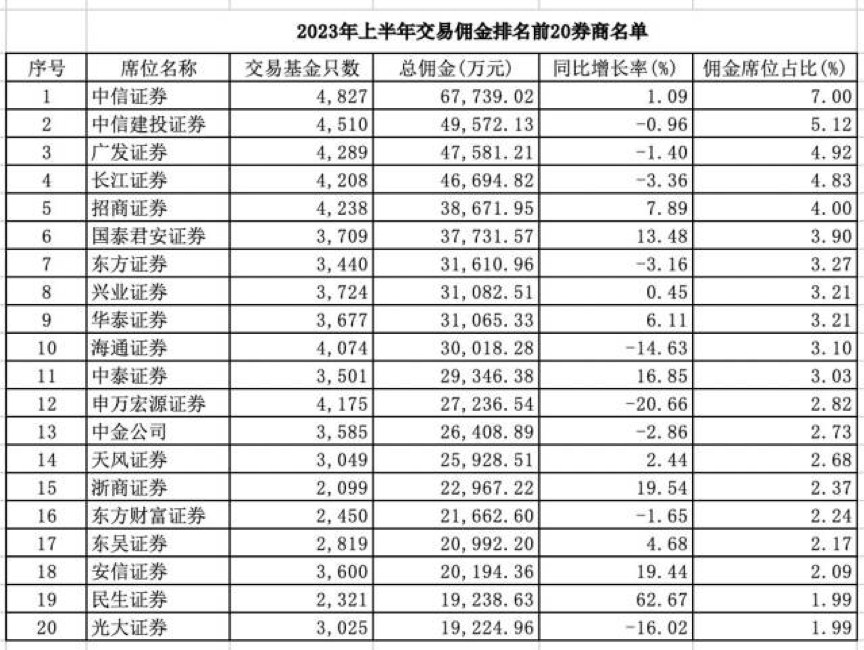
Wind data shows that head brokers with strong comprehensive strength, such as CITIC Securities, CITIC Jiantou, Guangfa Securities, China Merchants Securities and Guotai Junan, have the highest ability to obtain sub-warehouse commissions. Changjiang securities, TF Securities, Zheshang Securities, soochow securities and other characteristic securities firms with strong research strength have also gained a considerable share in the market.
"Although the sub-warehouse commission income only accounts for a small part of the total income of the securities industry, it is still an important source of profit for brokers mainly engaged in research business. This rate reduction has had a direct impact on most brokerage research institutes. " The person in charge of a large brokerage research institute in Beijing said.
"In addition to the research service itself, the commission paid by the institution also includes the cost of product sales and soft services. Usually, research expenses account for about 30%-40% of the total commission, and some brokers set the commission distribution ratio of investment and research services, channel consignment rebates and inclined shareholders to 40%, 40% and 20%. " The head of a large brokerage research institute in East China told the interface news.
"In contrast, the proportion of large brokers in commission income is not high, while the competition for market share of small and medium-sized brokers will be more intense." The person said.
In addition, there are frequent changes in brokerage researchers, and some reasons areIn recent years, the number of employees has been growing.The state of "supply exceeds demand" has also led to serious volume in the industry.
Choice data shows that by the end of January 2024, the number of analysts registered with the Securities Industry Association had reached 4,636, an increase of over 700 over the same period of last year; At the same time, the number of brokerage research institutes with a scale of more than 100 people has also increased from 6 in 2019 to 13 in 2024.
"The number of analysts who have left and re-searched for opportunities has increased significantly, which has also given the impression of external talent surplus." A brokerage chief said.
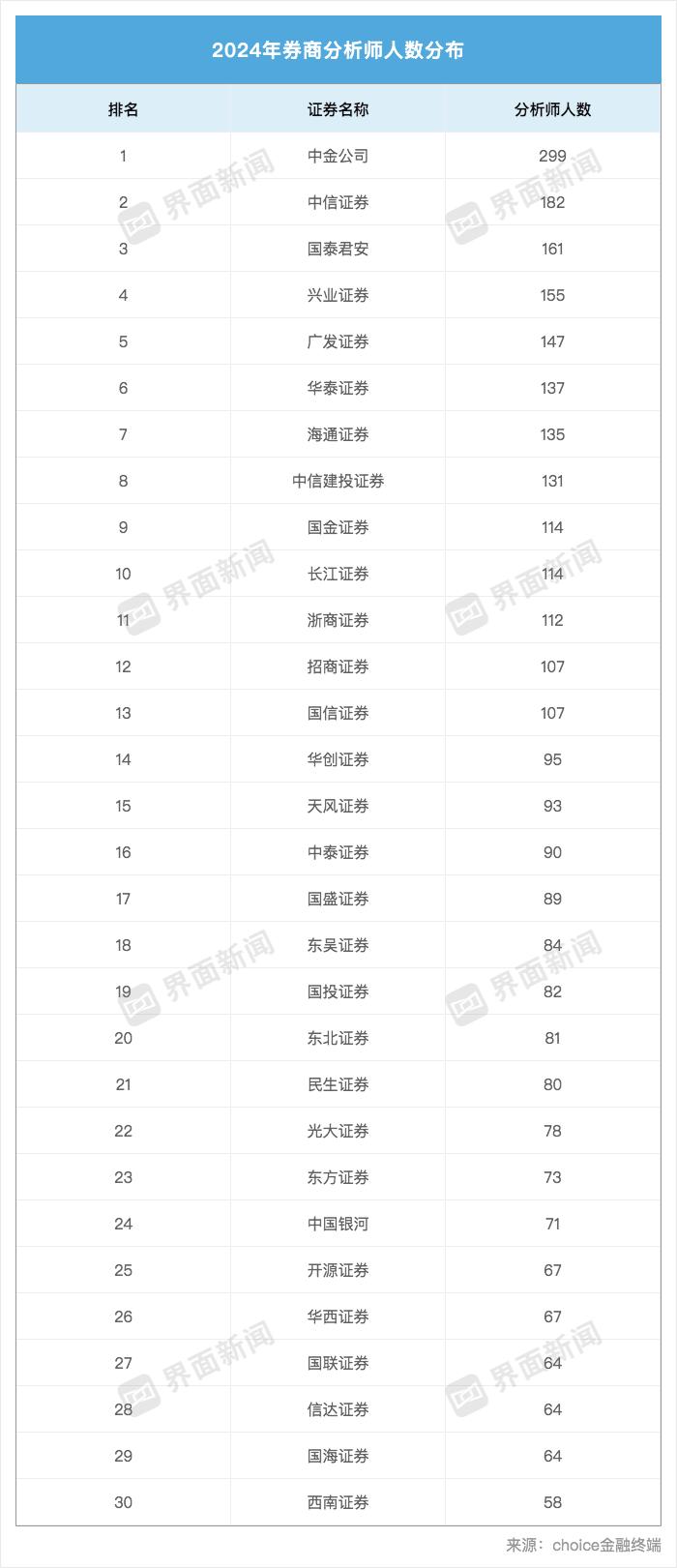
With the acceleration of the transformation of brokerage research institutes, how will the industry competition pattern evolve?
In fact, the personnel changes in the brokerage research institute have intensified, which further reflects that the pace of transformation and reform in the brokerage research institute is accelerating.
There have been many discussions in the industry about the transformation of the institute.Among them, there are many ways to explore, including cooperating with internal services and gradually changing the absolute dependence on the commission of public offering. Previously, a number of brokers emphasized in their financial reports that they should improve the efficiency of research transformation, coordinate internal and external empowerment, and explore diversified income models.
Dongxing securitiesChief analyst of non-bank financial industryLiu Jiawei believes: "In the profit structure of brokerage research institute, the proportion of income brought by research services will continue to increase and eventually reach a very high value. At the same time, it is inevitable to provide internal services, especially for brokers whose shareholders are group companies. "
However, at present, the profit contribution of collaborative business is less, and the brokerage research business mainly depends on the commission of sub-positions.
"The future development prospect of the research institute’s inward service is actually unclear. How to coordinate and run in with various departments is a great test. For the researcher personally, the salary assessment system will also change. Even if it is transferred to the interior, it is inevitable to reduce the salary in the current environment." Some brokerage analysts said.
He believes that for individual researchers, it used to be one of the common paths of career development to change jobs from "seller" to "buyer". However, if the research institute turns to internal service, researchers may not be able to contact institutional investors, and it is difficult to see the market performance of the research results.
Liu Jiawei said,It is still difficult to realize the mode of making profits solely by internal services for the time being. Large brokerage firms have relatively more resources and high quality, while small and medium brokerage firms are more dedicated to services. But no matter how big or small, it is a long-term solution only if you can get income continuously and stably.
Jiang Han, a senior researcher at Pangu think tank, believes that the reform and transformation of brokerage research institutes can be exerted in many ways. First of all, in the face of the new situation, the brokerage research institute can consider transforming into a research institution that pays more attention to depth and professionalism, and strengthen the research on specific sub-sectors or themes. Secondly, by integrating internal resources, the institute can strengthen the linkage with other business departments, provide integrated financial service solutions, and improve the added value of services. Thirdly, brokerage research institutes should actively embrace digital transformation, use advanced technologies such as big data and artificial intelligence to improve research efficiency and quality, and develop intelligent investment research tools and platforms to provide customers with more convenient and efficient service experience.
In the eyes of the industry, under the background of Public Offering of Fund’s commission reduction and fee reduction, the research business is facing the problem of reduced income and intensified personnel turnover, which will have a far-reaching impact on the seller’s competition pattern and business layout.
"Under the general trend, the head brokerage research institute with a certain scale is no longer limited to the competition of sub-warehouse commissions, but more attempts are made to develop in the direction of integrated financial services. Internally, they cooperate more closely with business departments such as self-management, asset management and investment banking; Externally, they strengthen the coverage of industrial research and large asset management to expand the scope of their own research. " The person in charge of a large brokerage research institute in Beijing said.
He believes that from the perspective of the future development pattern of the institute, the trend of investment banks and institutions becoming more and more obvious, and the trend of decentralization of the institute in the past is also changing.