Zhongxin Jingwei Client September 29th (Seimi Zhang) This year’s National Day Mid-Autumn Festival lasts for 8 days from October 1st to October 8th, and the National Day Mid-Autumn Festival overlaps. In addition, the epidemic prevention and control continues to improve, and the demand for holiday travel is released in a centralized way. The traffic control department predicts that there will be a peak of road traffic in China, mainly for tourism and visiting relatives, and the "two festivals" will come. Which sections of the first-tier cities in Guangzhou, Shenzhen and Shenzhen are prone to congestion? How to bypass the blocking point? The Zhongxin Jingwei client will take you through.
Ministry of Public Security: From 14: 00 to 23: 00 on September 30, the national expressway will continue to be congested
On September 27th, the Ministry of Public Security combined with the map of Gaode predicted the top ten popular highway sections in China during the long holiday, which were mainly located in the Yangtze River Delta and Guangdong-Hong Kong-Macao Greater Bay Area.
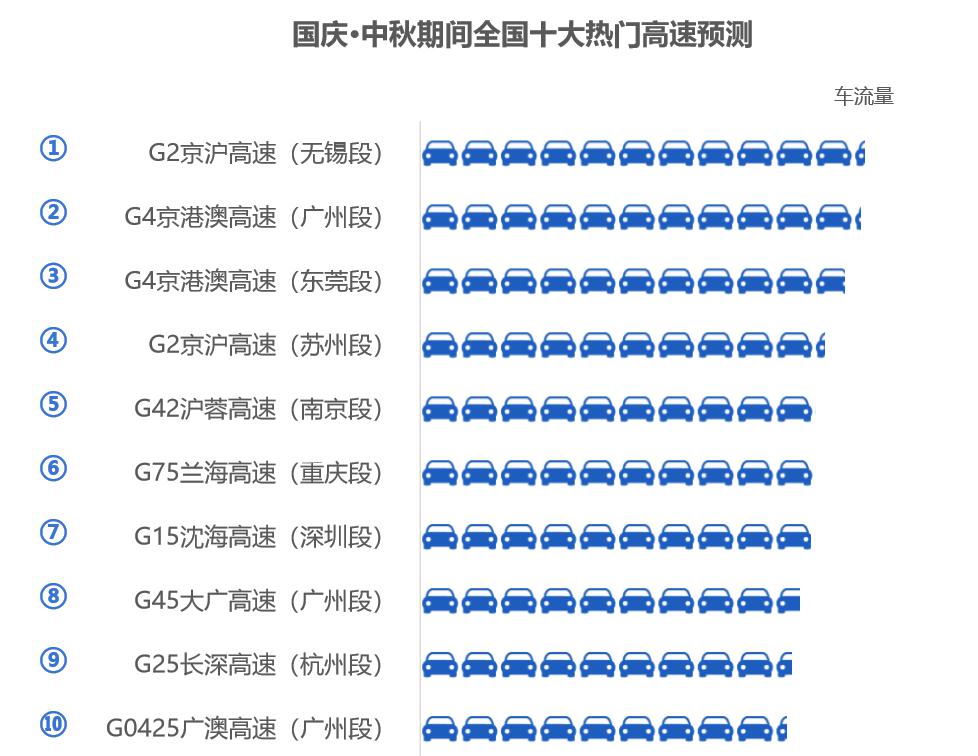
Source: 2020 Mid-Autumn National Day Holiday Safe and Smooth Guide
Among them, G2 Beijing-Shanghai Expressway (Wuxi section) has the largest traffic volume, followed by G4 Beijing-Hong Kong-Macao Expressway (Guangzhou section, Dongguan section) and G2 Beijing-Shanghai Expressway (Suzhou section).
In terms of congestion-prone periods, it is expected that there will be continuous congestion on the national expressway from 14: 00 to 23: 00 on September 30, and there will be a congestion peak on October 1, in which 9: 00 am to 12: 00 am is the peak travel period, and the peak appears from 10: 00 to 11: 00.
These places around Beijing Expressway are prone to congestion when entering and leaving Beijing.
The traffic police in Beijing suggested that it is expected that the major expressways leading to suburbs and surrounding provinces and cities such as Beijing-Tibet, Jingcheng, Airport, Beijing-Hong Kong-Macao, Jingkai, Beijing-Shanghai and Jingha during the Mid-Autumn Festival of National Day this year will have a prominent traffic pressure from 6: 00 to 12: 00 on October 1 and 2, and 10: 00 on October 1 is the time when the traffic pressure is the greatest during the National Day holiday; From 16: 00 to 19: 00 on October 6, 7 and 8, the traffic flow into Beijing was particularly concentrated.

Source: Public Security Traffic Management Bureau of Beijing Public Security Bureau
Beijing traffic police predict that the traffic pressure on Beijing-Tibet, Jingcheng, Airport, Beijing-Hong Kong-Macao, Jingkai, Beijing-Shanghai, Jingha and other expressways and some national highways leaving Beijing will increase significantly from 6: 00 am to 12: 00 am on October 1 and 2, including Qinghe Toll Station of Beijing-Tibet Expressway, Shahe Bridge, Xiguan of Changping, Juyongguan and the exit of Wildlife Park, Wanghe Bridge and Laiguangying Bridge of Jingcheng Expressway and Dujiakan of Beijing-Hong Kong-Macao Expressway.

Source: Public Security Traffic Management Bureau of Beijing Public Security Bureau
The traffic police in Beijing predicted that the traffic pressure in the direction of Beijing will increase obviously from 14: 00 to 18: 00 on October 6 to October 8, among which Kangzhuang, Juyongguan, Xisanqi, Beishatan on Beijing-Tibet Expressway, Huanggang and Taiyanggong on Beijing-Chengde Expressway, Liulihe and Xidaokou on Beijing-Hong Kong-Macao Expressway, Yuquanying, Xinfadi and Yufa on Beijing-Kaikou Expressway are all points where there are many cars in the direction of Beijing.
The longest congestion time in Shanghai is 13 hours and 17 hours respectively.
The Shanghai traffic police reminded that it is expected that the peak of high-speed traffic congestion will be from 14: 00 to 20: 00 on September 30; October 5 and October 6 are the return congestion peaks, and the congestion peaks are from 14: 00 to 19: 00.
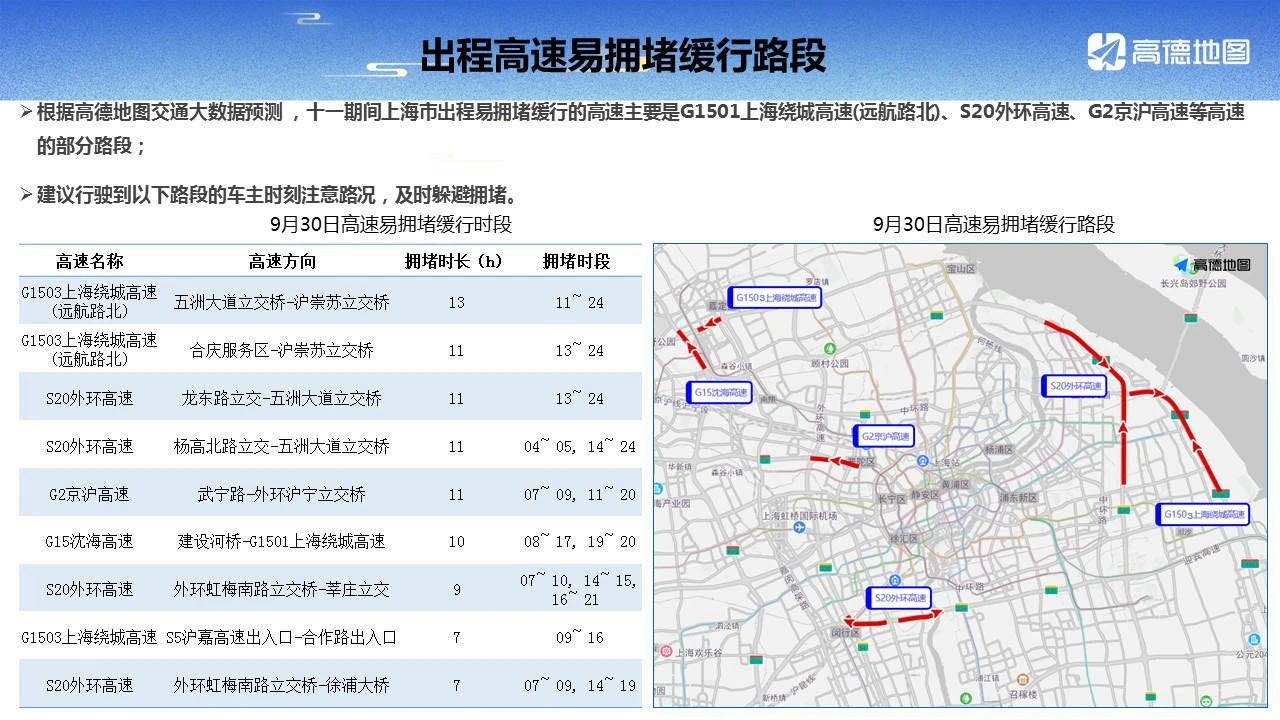
Source: "Focus 4 Shanghai Traffic Police Micro Release" micro signal
According to the Shanghai traffic police, according to the traffic big data forecast of Gaode map, the high-speed roads that are easy to block and slow down in Shanghai during the eleventh period are mainly G1501 Shanghai Ring Expressway (north of Yuanhang Road), S20 Outer Ring Expressway, G2 Beijing-Shanghai Expressway and other high-speed sections. Among them, G1501 Shanghai Ring Expressway (north of Yuanhang Road) Wuzhou Avenue overpass — Direction of Shanghai-Chongsu Overpass and Heqing Service Area — The congestion duration in the direction of Shanghai Chongsu overpass is 13 hours and 11 hours respectively, and the congestion period is from 11: 00 to 24: 00 and from 13: 00 to 24: 00 respectively.
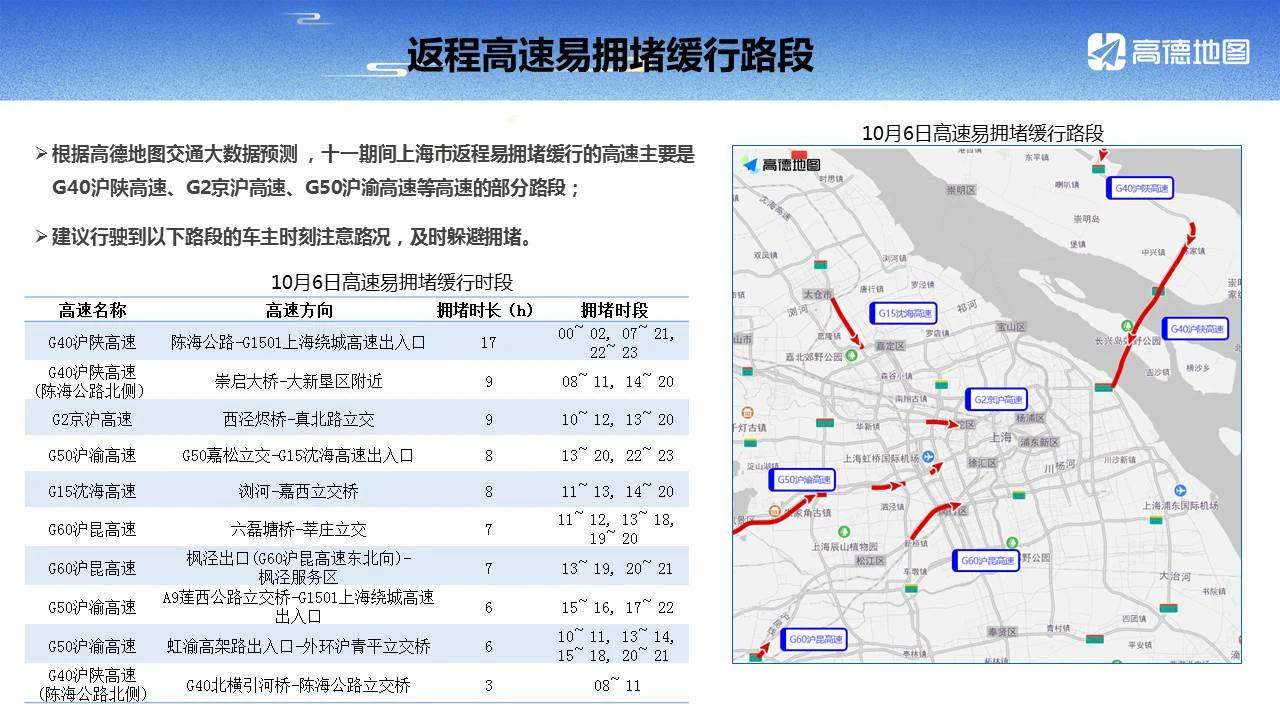
Source: "Focus 4 Shanghai Traffic Police Micro Release" micro signal
In addition, the high-speed roads that are easy to block and slow down on the return trip in Shanghai are mainly some sections of high-speed roads such as G40 Shanghai-Shaanxi Expressway, G2 Beijing-Shanghai Expressway and G50 Shanghai-Chongqing Expressway. Among them, G40 Shanghai-Shaanxi Expressway Chen Hai Highway — The entrance and exit of G1501 Shanghai Ring Expressway is congested for 17 hours, and the congested sections are from 0: 00 to 2: 00, from 7: 00 to 21: 00, and from 22: 00 to 23: 00.

Source: "Focus 4 Shanghai Traffic Police Micro Release" micro signal
In terms of congested road sections in Shanghai, during the Eleventh Holiday, Shanghai Wuzhou Avenue, Xiangyin Road Tunnel, Renmin Road, Yan ‘an East Road and Yan ‘an Elevated Louis were congested, among which Wuzhou Avenue went from Xiangyin Road Tunnel to G1501 Shanghai Ring Expressway — The congestion delay index from west to east is 4.7, and the average speed is 15 km/h.
Guangzhou released a detour route for congested road sections.
Guangzhou traffic police predicted that on the day of the "Double Festival", some trips to visit relatives and return home will tend to be concentrated in the afternoon of September 30, after work and the morning of October 1; Local travel tends to travel on the morning of October 2.
Among them, it is expected that there will be more serious congestion on 10 roads in Guangzhou at the peak of September 30. TOP1 is Guang Yuan Middle Road (Yunshan South Road-Airport Section), and the congested areas include Yuexiu District (Dongfeng Middle Road and Huanshi Middle Road) and Liwan District (Kang Wang North Road, Dongfeng West Road and Huangsha Avenue), Tianhe District (Tianhe East Road) and Haizhu District (Liede Avenue).
In terms of high-speed, this year’s high-speed "blocking" bureau is expected to begin to appear at 12 noon on September 30, and the congested high-speed TOP1 is S303 South China Expressway (Cencun Interchange -G4 Beijing-Hong Kong-Macao Expressway) with the most serious traffic congestion. Followed by airport expressway and ring expressway. During holidays, Sanyuanli-Banghu Interchange Section of Airport Expressway; Huashan Interchange-Huashan Tunnel Section of Leguang Expressway; Chungang Interchange-Shimentang Tunnel Section of South China Expressway; The traffic in the bottleneck sections of Guanfo Expressway, such as Tanwei Interchange-Humen Bridge and North Third Ring Road (Airport North Interchange-Yanghe Lijiao), is dense, and it is expected that there will be frequent slow driving, resulting in a long slow driving distance.
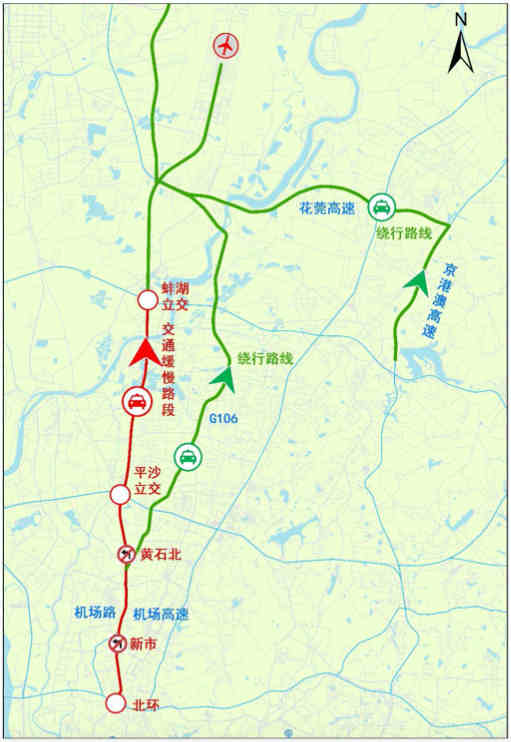
Airport high-speed control measures and bypass map. Source: "Guangzhou Traffic Police" micro signal
Guangzhou traffic police suggested that when leaving the city, Guangzhou should go to the airport. In order to avoid the slow section of the airport, it is suggested to choose the ground road as far as possible and bypass the ground road such as Helong Road (G106). Some passengers can transfer to Huaguan Expressway via Beijing-Hong Kong-Macao Expressway to the airport.

A detour map of passengers going to the airport in western and eastern Guangdong. Source: "Guangzhou Traffic Police" micro signal
Passengers going to the airport in western Guangdong and eastern Guangdong are advised to bypass the airport expressway through the North Third Ring Road and avoid the slow-moving sections such as the North Second Ring Road. In order to avoid the slow-moving section of Chungang Interchange-Shimentang Tunnel, it is suggested to bypass Zhong Luotan via Guangcong Highway (G105) and continue northward. Citizens who are going to Conghua are advised to go to Badou Interchange via Guangzhou-Shantou Highway and continue northward.
In addition, the Guangzhou traffic police predicted that the returning traffic will start from October 6th until the end of the holiday. Expressway return: the afternoon of October 6 -8 is the main congestion period, and the congestion is the most serious on the afternoon of October 7 and 8, or it will last until night; In terms of roads in the central city: Except for the congestion in some sections from the afternoon of October 7 and October 8, the overall traffic operation is expected to be relatively normal.
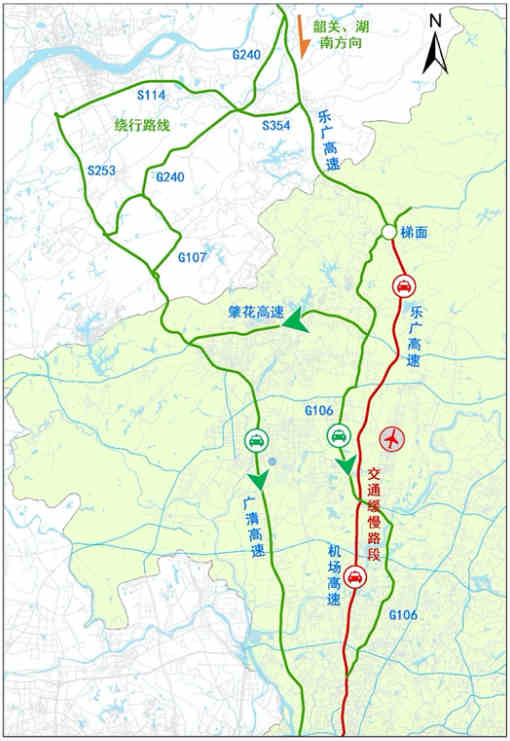
Airport expressway southbound detour map. Source: "Guangzhou Traffic Police" micro signal
On the return trip, Guangzhou traffic police advised car owners from Shaoguan and Hunan to avoid the rush hour and return to the city as much as possible. Car owners returning to the city during the rush hour can bypass the ground transportation such as National Highway G106 or Guangqing Expressway to avoid the slow-moving section of Huashan-Airport.

Airport passenger return detour map. Source: "Guangzhou Traffic Police" micro signal
Guangzhou traffic police advised passengers from the airport to avoid the slow-moving sections such as Pingsha Interchange and Huangshi-Sanyuanli Interchange through Helong Road (G106).
Shenzhen-Shantou Expressway has the largest single lane traffic.
Shenzhen traffic police predicted that September 30th to October 2nd would be the peak of deep congestion. October 6, 7 and 8 are the peak of return congestion.
In the depth direction, G15 Shenhai Expressway, S31 Longda Expressway, S33 Nanguang Expressway, East Coast Expressway and G4 Beijing-Hong Kong-Macao Expressway are prone to congestion.
In the deep direction, there are G15 Shenhai Expressway, Huiyan Expressway, Wushen Expressway, East Coast Expressway, Yanba Expressway, especially the He ‘ao-Longgang section of Shenhai Expressway.
The Shenzhen Traffic Police predicted that the Meiguan Expressway, with the highest average single lane, will reach 16,000 vehicles/day, with the largest traffic volume. According to the statistics of traffic flow in and out of deep roads during the National Day holiday in previous years and referring to this year’s Dragon Boat Festival, Shenzhen-Shantou Expressway has the largest traffic flow, followed by Nanguang Expressway and G94 (Meiguan Expressway). In the depth direction, G94 (Meiguan Expressway) is the largest, followed by Guangzhou-Shenzhen Expressway along the Yangtze River and Shenzhen-Shantou Expressway.
Traffic control is implemented in these areas.
Traffic control in Tiananmen area during September 30th and 11th in Beijing.
In Beijing, the flag-raising ceremony ended from 22: 00 on September 29 to October 9, and vehicles were banned from the surrounding roads such as the east and west roads of Tiananmen Square and the south road of the Great Hall of the People.
From 6: 30 on September 30 to the end of the activity, motor vehicles are prohibited from getting on and off passengers on the east side road and the west side road of Tiananmen Square, and buses are allowed to pass by.
From 7: 00 on September 30 to the end of the event, the south side of the Great Hall of the People, the intersection of Zhengyi Road in Dongjiaominxiang (excluding) to the west exit of the New World, the intersection of the west side of the Great Hall of the People and Xijiaominxiang (excluding) to the east exit of Xijiaominxiang, the east and west Tongzi River Road, and the north of Jinshui Bridge in Tiananmen Square to the north wall of the Forbidden City, all other vehicles and pedestrians are prohibited from passing; Non-motor vehicles and pedestrians are prohibited from passing on the east side of Tiananmen Square and the west side of Tiananmen Square; The two-way section of Chang ‘an Street from the south exit of Nanchang Street (excluding) to the south exit of Wang Hongbin Street (excluding) is closed to pedestrians; Chang ‘an Street runs from the south exit of Fuyou Street (excluding) to the south exit of Nanheyan Street (excluding) in both directions. It is forbidden for motor vehicles to get on and off passengers. Buses and subways on both sides of the line pass by, and Qianmen Station of Metro Line 2 passes by.
From 8: 00 on September 30 to the end of the event, no other vehicles are allowed to pass on the east side road of Tiananmen Square and the west side road of Tiananmen Square, except those with special documents for the ceremony. Buses passing through the east side road and the west side road of Tiananmen Square bypass North Xinhua Street, Zhengyi Road and Taijichang Street.
From 9: 40 on September 30th to the end of the activity, the east and west streets of Qianmen are closed to motor vehicles from the south exit (excluding) of the west side road of the Great Hall of the People to the south exit (excluding) of Zhengyi Road.
From 9: 40 to 10: 15 on September 30, Chang ‘an Street was closed to all kinds of vehicles and pedestrians from the south exit of Nanchang Street (excluding) to the south exit of Nanheyan Street (excluding).
Some roads in Shanghai are closed to motor vehicles.
In Shanghai, traffic control is implemented from 16: 30 to 23: 30 every day from September 30 to October 7.
In Puxi area: along Liyang Road (south of Changzhi Road) — Changzhi Road — Tiantong Road — Qufu Road — Xizang North Road — Tibet Middle Road — Beijing West Road — Chengdu North Road — Chongqing Middle Road — Chongqing South Road — Huaihai Middle Road — Huaihai East Road — Renmin Road — Motor vehicles are prohibited from passing on the ground roads in the area enclosed by Dongmen Road and Huangpu River (excluding the above roads). Yan ‘an Elevated Road (east of North-South Elevated Road), only motor vehicles leaving the Bund Tunnel on Yan ‘an Elevated Road and entering Yan ‘an East Road Tunnel and Bund Tunnel via Yan ‘an Elevated Road are allowed to pass. Yan ‘an East Road Tunnel (from Puxi to Pudong) only allows motor vehicles to pass through Yan ‘an Elevated Road, exit Fujian Road and enter Yan ‘an East Road Tunnel. In Pudong area: along Baibu Street — Lujiazui Ring (North) Road — Lujiazui Ring (South) Road — The roads in the enclosed area of Shibu Street and Huangpu River (excluding the above roads) are prohibited from passing by motor vehicles.
For non-motor vehicle traffic control, along South Suzhou Road (east of Henan Middle Road) — Henan Middle Road — South Henan Road — Renmin Road — The roads in the enclosed area of Xinkaihe Road and Huangpu River (including the above roads) are prohibited from passing by non-motor vehicles.
Temporary control by sections and grades is implemented on some expressways in Guangzhou.
Guangzhou traffic police reminded that the traffic police department will follow the Guangzhou Airport Expressway (Sanyuanli Interchange — Benghu Interchange Section) The northbound main line runs slowly. According to the traffic situation, the northbound Xinshi, Huangshi North Entrance, and the North Ring Road, Huakuai Phase III and North Second Ring Road turn to the airport expressway ramp are temporarily controlled by sections and grades.
Guangzhou traffic police said that if the traffic on the northbound main line of Leguang Expressway (Huashan Interchange-Huashan Tunnel) is slow, the traffic police department will temporarily control the entrance of East Lake according to the on-site traffic conditions. If the traffic in Chungang-Shimentang tunnel section of South China Expressway is slow, the traffic police department will borrow the opposite lane from the south entrance to the north exit of Shimentang tunnel according to the on-site traffic situation; At the same time, intermittent control is implemented at the entrance of Longdong toll station in a timely manner.