CCTV News:On March 15th, the National Health and Wellness Commission and state administration of traditional chinese medicine issued the "novel coronavirus Diagnosis and Treatment Plan (Trial Ninth Edition)". The new diagnosis and treatment plan has made many major updates in detection, management and treatment, optimized the procedure of case discovery and reporting, and added antigen detection as a supplement to further improve the ability of case early detection. At the same time, the cases were classified and treated, and the light cases were changed from being admitted to hospitals to centralized isolation management.
The diagnosis and treatment plan further improves the measures of case classification and treatment

In the case treatment, the new diagnosis and treatment plan further improved the case classification treatment measures according to the opinions reflected by various places, such as "asymptomatic infected patients and mild cases are the main patients in Omicron, and most of them don’t need too much treatment, and all of them will occupy a lot of medical resources when they are admitted to designated hospitals".
Light cases changed from income hospital to centralized isolation management.
For the confirmed cases, the new version re-classifies them into light, ordinary, heavy and critical types. Light cases are subject to centralized isolation management, and relevant centralized isolation places cannot isolate people such as entry personnel and close contacts at the same time. During the period of isolation management, symptomatic treatment and condition monitoring should be done well. If the condition worsens, it should be transferred to a designated hospital for treatment.
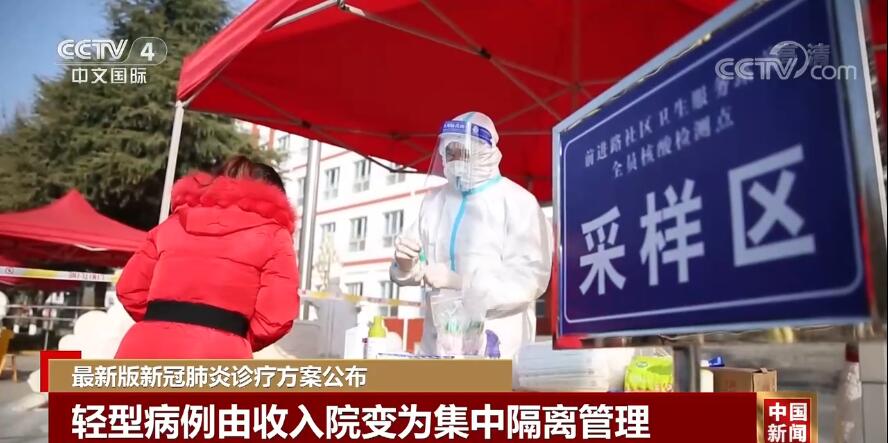
At present, asymptomatic and mild cases account for the majority, and the new version of the diagnosis and treatment plan is expected to reduce the burden of treatment for designated hospitals and medical staff, reduce the risk of medical resources run, and achieve more accurate management. In addition, ordinary, severe and critical cases and cases with severe high-risk factors should be treated in designated hospitals, and severe and critical cases should be admitted to ICU as soon as possible.
Two new specific anti-Covid-19 drugs were added.
In terms of specific drug treatment, the new diagnosis and treatment plan has added two COVID-19 antiviral drugs newly approved by National Medical Products Administration..Revise and improve the content of TCM treatment. Combined with the clinical treatment experience in various places, the application of non-drug therapy in traditional Chinese medicine was strengthened and the content of acupuncture treatment was increased; Combined with the characteristics of children patients, the related contents of traditional Chinese medicine treatment for children were added.
The plan also adjusts the management of release from isolation, discharge standards, release from isolation and matters needing attention after discharge. For example, the "14-day isolation management and health monitoring after discharge" was changed to "release isolation management or continue home health monitoring for 7 days after discharge".

On the basis of nucleic acid, antigen detection is added as a supplement
The plan proposes to add antigen detection as a supplement on the basis of nucleic acid detection to further improve the ability of early detection of cases. The relevant person in charge of the National Health and Wellness Commission stressed that the antigen positive must be linked to the nucleic acid detection in a closed loop, and the antigen positive result can be used for early triage and rapid management of suspected people, and cannot replace the nucleic acid detection to determine whether the detected person is infected with COVID-19.
Li Jinming, Deputy Director of Clinical Laboratory Center of National Health and Wellness Commission:The specificity of antigen detection can reach 99%, but the specificity of nucleic acid detection in methodology is 100%, so nucleic acid detection has always been a basis and a "gold standard" for determining COVID-19 infection, so antigen detection cannot replace nucleic acid detection. When the antigen test is positive, you must take the nucleic acid test to confirm it; But the nucleic acid test is positive. No matter whether your antigen test is negative or positive, the examinee should take measures as an infected person or a confirmed patient in COVID-19.