50 basis points! The Fed is raising interest rates for the seventh time! Will interest rates be cut next year? Powell’s position! US stocks plunged across the board, and international oil prices conti
As expected by the market, the Federal Reserve announced a 50 basis point interest rate hike!
The Federal Reserve announced a 50 basis point interest rate hike.
On December 14th, local time, the Federal Reserve announced that it would raise the target range of the federal funds interest rate by 50 basis points to between 4.25% and 4.5%, which is the seventh time that the Federal Reserve raised interest rates this year.
In addition, the Fed predicts that the federal funds rate will peak at 5.1% next year, and it is expected that the interest rate will drop to 4.1% by the end of 2024 and 3.1% by the end of 2025. The Fed also predicts that the unemployment rate will also rise next year, and by the end of 2023, the unemployment rate will rise from the current 3.7% to 4.6%.
It is reported that the Federal Reserve raised interest rates by 75 basis points for four consecutive times in June, July, September and November this year, and the decision to raise interest rates by 50 basis points indicates the slowdown of interest rate hikes.
After the Federal Reserve announced its decision to raise interest rates by 50 basis points, Federal Reserve Chairman Powell delivered a speech, saying that the Fed expected that the continuous interest rate hike would help restore the inflation rate to the target of 2%. He also pointed out that it is not expected to cut interest rates in 2023, and the rate increase announced at the meeting in February next year will depend on economic data.
Powell said that compared with last year’s rapid development, the US economy has slowed down significantly. He pointed out that raising interest rates will not cause the economy to fall into recession, and the Fed should not consider cutting interest rates until it is convinced that the inflation rate will continue to drop to 2%.
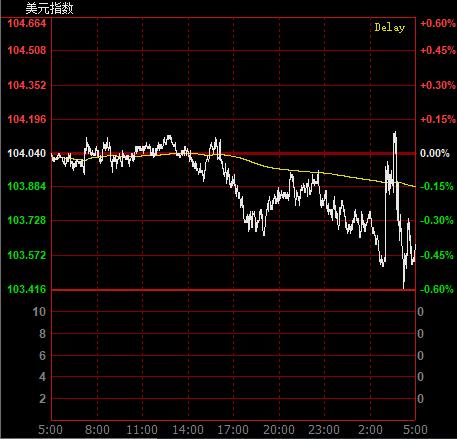
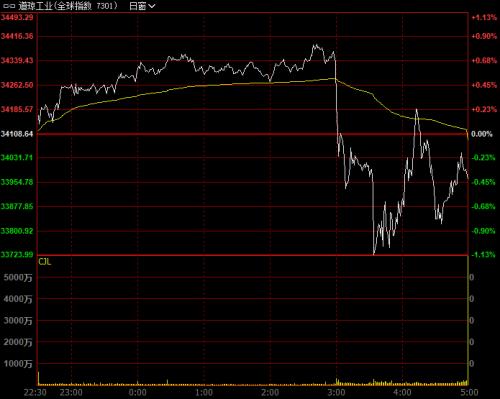
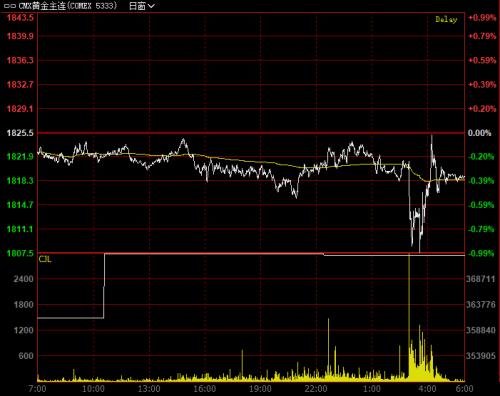
After the announcement of the Federal Reserve’s decision to raise interest rates, the US dollar index surged back, US stocks turned from rising to falling, and international gold prices plunged in the short term.
As of late trading in new york, the US dollar index, which measures the US dollar against six major currencies, fell 0.21% to 103.7700.
The three major US stock indexes closed down across the board. At the close, the Dow closed down 142.29 points, or 0.42%, to 33,966.35 points. The Nasdaq fell 85.93 points, or 0.76%, to 11,170.89 points; The S&P 500 index fell 24.33 points, or 0.61%, to 3,995.32 points.
At the close, the main contract of COMEX gold futures fell by 6.8 USD/oz compared with the previous trading day to close at 1,818.7 USD/oz, with a decrease of 0.37%.
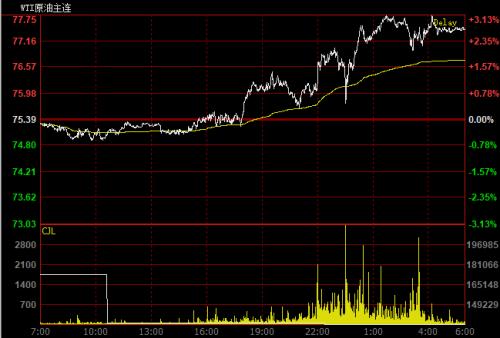
International oil prices bottomed out and rebounded.
Recently, crude oil prices in both internal and external markets have rebounded to some extent. Market participants said that the sharp rebound in oil prices in the internal and external markets was due to the fact that the CPI data in the United States fell more than expected in November, and the market risk appetite continued to improve, superimposed on the marginal improvement of the actual supply and demand side.
International oil prices rose significantly on Wednesday. As of the close of the day, the main contract of WTI crude oil futures rose by 1.89 USD/barrel to close at 77.28 USD/barrel, an increase of 2.51%; The main contract of Brent crude oil futures rose by 2.02 USD/barrel to close at 82.70 USD/barrel, with an increase of 2.50%.
According to data released by the us energy information administration (EIA) on Wednesday, as of the week of December 9, commercial crude oil inventories in the United States increased by 10.231 million barrels, which is expected to decrease by 3.595 million barrels, and the previous value decreased by 5.186 million barrels.
"After the oil price continued to fall sharply, the short-selling energy was fully released, and the short-term oil price had its own repair needs. In addition, the most worrying factor in the previous market was weak demand. With the optimization and adjustment of the epidemic prevention and control policy in China, the expectation of the resumption of crude oil demand in the world’s largest crude oil importing country returned to the market. From the performance of the domestic refined oil market in recent days, the market expected this strongly, and with the recovery of market sentiment, oil prices began to rebound. The US CPI data released on Tuesday was lower than expected, which further increased the expectation of the Fed’s interest rate hike slowdown, and the slowdown in interest rate hike also helped the market sentiment to pick up. " An Yang, head of energy and chemical research and development in haitong futures, said.
According to Zhang Zhengze, an analyst at Guohai Liangshi Futures Research Institute, the reason for the rebound of oil prices in the internal and external markets lies in the improvement of the marginal supply and demand at the real end, which is driven by macro emotions. It can be seen that the unilateral and near-end monthly difference of the disk and the price difference of refined oil cracking are simultaneously strengthened. He further explained that there are two reasons for the phased improvement of supply and demand in reality: one is the keystone pipeline problem, and Cushing may continue to go to the warehouse, which will narrow the Contango structure of WTI near-end monthly difference; Second, the natural gas in the European market entered the stage of de-stocking, and the influence of weather change on the slope of natural gas de-stocking was traded again, which led to the strength of primary energy prices. From a macro perspective, the CPI data of the United States in November was lower than expected, and the market’s concerns about the subsequent interest rate hike have eased.
In addition, the reporter noted that american petroleum institute (API) data showed that in the week ending December 9, US crude oil inventories increased by about 7.8 million barrels, far exceeding market expectations, and analysts expected that inventories would decrease by 3.6 million barrels. In this regard, An Yang said that this is an obviously bad data, but it is not sensitive from the market reaction during the day on Wednesday, which shows that investors are not very concerned about this short-term supply and demand data, but are more concerned about the interpretation of the supply and demand level in the future. At present, the expected recovery of demand, including China, still has a greater impact on oil prices, so the rebound of oil prices is expected to continue further in the near future.
"The important reason for the low pressure on crude oil inventories in the United States this year is the high operating rate of refineries, and the reason why the operating rate of refineries remains high is the high profit of refined oil products in Europe and America. However, from the trend point of view, with the lagging effect of interest rate hike on crude oil terminal demand, it is difficult for subsequent refineries to maintain high profits in the early stage, and it is difficult for refineries to show super-seasonal high start-up with high probability. The negative feedback logic of the demand side of refined oil will be transmitted to the demand side of crude oil through the operating rate of the refinery, which will lead to the accumulation of crude oil. Unless the price is further squeezed out of supply, such as OPEC+, it will change the pattern of gradual accumulation in the future. " Zhang Zhengze said.
The latest monthly report released by OPEC on Tuesday lowered the crude oil demand forecast for the first quarter of next year. In addition, the internationally renowned investment bank Goldman Sachs also significantly lowered its crude oil price forecast for the first half of next year. In this regard, An Yang said that OPEC has kept a cautious assessment of demand for some time in the past, because it has noticed the pressure that the global economy will face next. In addition, OPEC’s plan to reduce production by 2 million barrels per day in the early stage made the United States and other consumer countries dissatisfied. In order to alleviate this situation, OPEC has been explaining its production reduction, and lowering demand is obviously the most powerful support for its decision to reduce production. However, Goldman Sachs lowered its oil price expectation because of the real pressure. The sharp drop in oil price is obviously a judgment of "hitting the face" in its previous period. After this round of oil price continued to fall sharply and the overall structure weakened, Goldman Sachs also had to make adjustments to its forecast.
According to Huang Liunan, an analyst of Guotai Junan Futures, OPEC’s forecast of demand is relatively subjective, and it is not the core of market transactions. Most of the time, the crude oil derivatives market trades more around the economic context under the influence of the global debt cycle. OPEC’s downward adjustment of demand expectations may become a potential benefit for oil prices in the future, because OPEC’s pessimistic judgment on demand may lead to its greater production reduction. Overseas investment banks such as Goldman Sachs have a certain popularity in the crude oil market, but it does not mean that their analysis is accurate. Many overseas investment banks have a long-term perspective, which is different from the rhythm of domestic futures traders’ attention, and there is no need to over-interpret it.
"In fact, the weakening of crude oil demand in the first half of next year is relatively certain, which is also the negative feedback logic of demand for short-selling on the current disk. At present, the logic of weak demand for refined oil products in Europe and America may continue to suppress oil prices in the first half of next year. There is uncertainty about when China’s demand will bottom out, so it is necessary to keep a close eye on high-frequency leading indicators such as domestic travel data. From the perspective of travel leading indicators, China’s crude oil procurement demand will remain weak for more than one quarter. Looking at the time period, in the second half of next year, with the overseas interest rate hike cycle entering the interest rate cut cycle and the domestic epidemic situation gradually stabilizing, the demand for crude oil may once again form a positive drive for oil prices. " Zhang Zhengze said.
The improvement of macro-environment has provided momentum for the rise of international oil prices in the short term. An Yang said that the US CPI data in November basically confirmed that the stage of the greatest inflationary pressure in the United States has passed, and most of the breakdown data showed signs of weakening, which means that the US inflation data will continue to fall in the future. "The direct impact of the fall in inflationary pressure is to slow down the Fed’s interest rate hike expectations and benefit the performance of risky assets. However, before the Fed stops raising interest rates, it means that liquidity will remain tight, which is unfavorable for economic recovery. From this perspective, it will put pressure on the commodity market, so the market will carefully observe the subsequent changes in CPI in the United States and the downward pressure on the economy. The same is true for the impact on oil prices, which depends on investors’ reactions and changes in market sentiment. " He said.
Zhang Zhengze said that the stage of the greatest inflationary pressure in the United States may have passed, but the stage of negative impact on oil prices has not passed. It takes time for the process from the Fed to raise interest rates, to increase the financing costs of enterprises and individuals, and then to curb the demand for refined oil products at the end of crude oil. Therefore, there are two sets of logics in the market when the interest rate hike cycle drags down the oil price, that is, the logic of expectation and reality. In the initial stage of interest rate hike, the market will trade the expectation that interest rate hike will weaken demand. For example, in June-July this year, while crude oil fell unilaterally, the near-end monthly difference was strong. When the interest rate hike is expected to gradually approach the Fed’s bitmap, the interest rate hike may gradually enter the final stage, and the market will trade the impact of interest rate hike on the actual demand. At this time, the impact of the expected swing on the oil price will decrease. For example, since November this year, the crude oil disk has unilaterally fallen, and the near-end monthly difference has also fallen sharply, and the decline is even more fierce. The near-end monthly difference has driven the disk price to weaken, and the current negative feedback logic of the actual demand has not yet ended.
"Looking forward to 2023, the slowdown in demand growth in the global crude oil market is almost certain. There are still differences on whether to fall into recession. The trend of CPI in the United States is an important observation indicator. In the face of historical inflationary pressure, the main downside risk that the market needs to face in 2023 is still similar to that in 2022, that is, deflation risk caused by liquidity tightening. The fall of CPI in November may indicate the emergence of this pattern. Of course, considering the uncertainty of the Fed’s tightening policy, it is not clear whether it is a continuation of stagflation or deflation. It is only at the end of inflation that the commodity market will have a high probability of repeatedly trading the price drop under the risk of deflation and constantly correcting the expected difference. " Huang Liunan said that considering the impact of previous interest rate hikes on the economic downturn has never been accurately predicted, there will be many variables in the domestic and international monetary policies in 2023, and it is difficult to predict the direct impact rhythm of credit tightening on the reality and expectation of crude oil. The deep deduction of stagflation pattern and the uncertainty triggered by geo-risks have made it more difficult to judge the demand, that is, whether inflation will fall back quickly or slowly still needs to be observed, so it is not appropriate to draw a conclusion.
Huang Liunan believes that if the pace of CPI decline in the United States and Europe is very sharp and drives the market to trade deflation risks in advance, oil prices are likely to still face huge downward pressure in the first half of 2023, and even hit a low for the whole year. If the pace of CPI decline in the United States and Europe is relatively moderate, the negative transmission of oil prices will be relatively mild. At that time, the trading perspective of the crude oil market will return to the supply and demand side, and the focus of oil prices may still be at a high level for a long time in the process of inflation falling but not entering the deflationary pattern. In this case, even if the oil price may decline due to staged trading recession or contraction, the low price will not last for a long time and the average price will drop limited under the tight supply and OPEC+ production reduction.
This article is from: Futures Daily
Author: Wu Mengwen